
.jpg)
Commercial Property Leases Explained: Gross vs Net & Key Terms
August 21, 2026
Australian commercial leases come in three rent structures. Under a gross lease the tenant pays one figure and the landlord absorbs the property’s running costs. Under a net lease the tenant pays a base rent and then pays the outgoings on top, billed separately and reconciled against actual spend each year. A semi-gross lease sits between them: outgoings are built into the rent for the first year, and the tenant picks up increases after that.
That is the whole distinction. What makes it hard is not the concept. It is that the words are used loosely, the numbers are quoted on different bases, and the document in front of you may be labelled one thing while behaving like another.
This guide covers what each structure actually does to your costs, how to compare two quotes that are not on the same basis, what the law controls and what it leaves entirely to negotiation, and the lease terms that decide the deal once the rent is settled.
This is general information about commercial practice, not legal advice. Lease law differs by state and by whether your premises are retail. Get advice from a property lawyer before you sign anything.
The three structures, side by side
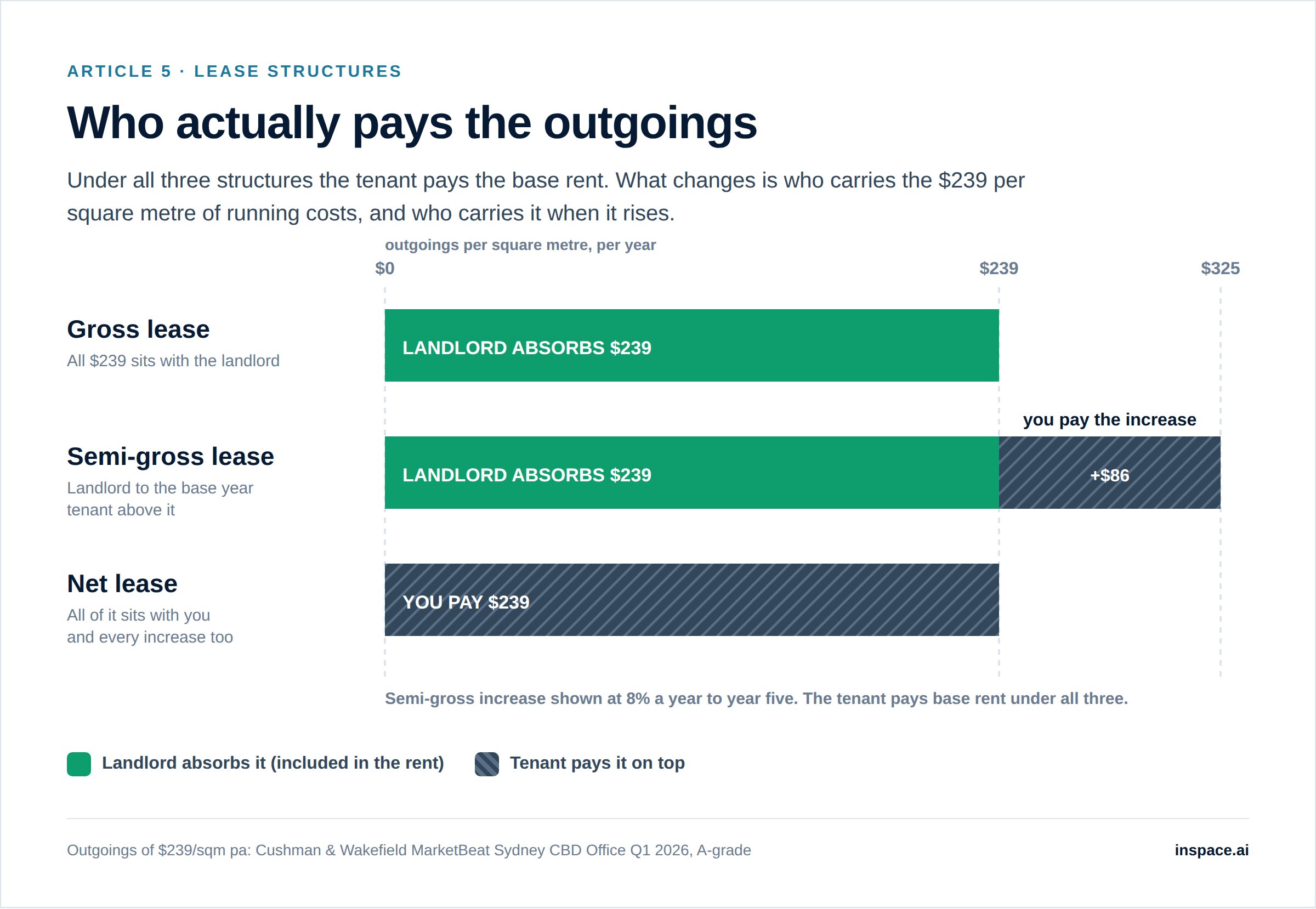
The headline rent tells you almost nothing on its own. A gross figure and a net figure for the same building are supposed to look different, and they will differ by roughly the cost of outgoings. That gap is not a discount.
Why the label on the lease is unreliable
Here is the part that catches people. Most leases described as “gross” in the Australian market are not fully gross.
Commercial property advisers Leasing Property Consultants published a piece titled When is a gross lease actually a gross lease?, which tells you how common the problem is. Their answer: a genuine gross lease has all outgoings in the rent, and what tenants are usually offered is a semi-gross arrangement structured one of two ways.
Structure one is the base year. Outgoings are included in the rent, but the tenant pays any increase above the first year’s figure. Their worked example: a tenant paying $50,000 a year in year one, where outgoings on the space rise from $10,000 to $12,000 in year two, pays $52,000 in year two.
Structure two is named outgoings only. The tenant pays rent plus specific line items and nothing else. Their example is a rent of $48,000 plus council and water rates of $2,000. There is no standard version of this. Which items are in and which are out changes from building to building.
Thomson Reuters Practical Law Australia defines a semi-gross lease as one where the tenant pays rent “together with a lesser contribution to outgoings than a tenant would make in a net lease”. Accurate, and very wide. “A lesser contribution” covers everything from a base year to two named rates.
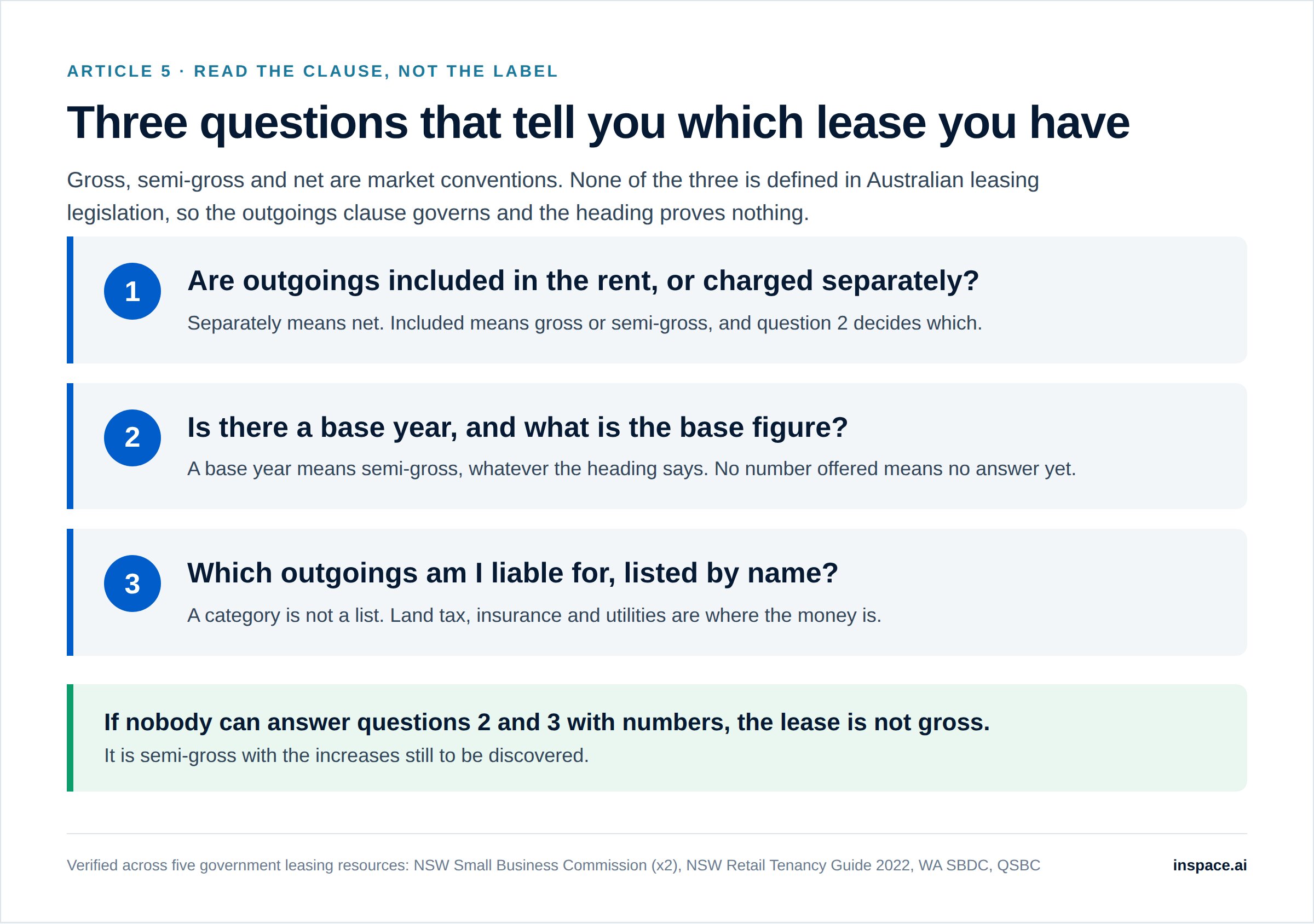
So the habit worth building is to stop reading the heading and read the outgoings clause. Three questions settle it:
- Are outgoings included in the rent, or charged separately?
- If they are included, is there a base year, and what is the base figure?
- Which specific outgoings am I liable for, listed by name?
If a landlord or agent cannot answer the second and third questions with numbers, the lease is not gross. It is semi-gross with the increases still to be discovered.
What outgoings cost, and why the structure matters more in cheaper buildings
Outgoings are the landlord’s costs of running the property, passed to the tenant. The NSW Small Business Commission describes them as “the costs incurred by the lessor in operating and maintaining the leased premises which are typically passed on to the lessee”, and its guidance lists land tax, cleaning, security, promotional fund levies, council rates, water charges, utilities, insurance, pest control, management fees and audit fees as examples. Western Australia’s Small Business Development Corporation lists much the same set.
They are not a rounding error. Cushman & Wakefield’s Sydney CBD office data for the first quarter of 2026 puts them at $239 per square metre a year for A-grade stock, against a net face rent of $1,320. That is a gross figure of $1,559, of which outgoings are 15.3%.

Read down the last column and something useful appears. Outgoings barely move between grades, because a secondary building still needs cleaning, insurance, rates and a lift service contract. Rent moves a lot. So outgoings are a much larger share of the total bill in cheaper stock: 18.3% in secondary space against 13.9% in premium.
That has a practical consequence. The further down the quality curve you are shopping, the more the lease structure decides your total cost, and the more a “cheap” net rent can mislead. In premium space, getting the structure wrong costs you around one dollar in seven. In secondary space it is closer to one in five.
The argument that matters most: outgoings do not rise at CPI
Rent reviews in Australian leases are usually a fixed percentage, a fixed amount, CPI, or a market review. The NSW Retail Tenancy Guide and the WA SBDC guidance both list those four.
Outgoings are not reviewed. They are simply what the costs turn out to be.
That distinction is doing real work at the moment. The Australian Bureau of Statistics recorded headline CPI at 3.8% for the twelve months to the June quarter of 2026. Inside that number, housing rose 6.8%, and electricity was 22.4% higher than a year earlier, largely because government rebates on household bills ended.
Electricity, insurance, council rates and cleaning wages are outgoings. So under a net lease, or above the base year of a semi-gross lease, the tenant carries the difference between what their rent review allows and what the building’s costs actually do. A CPI-linked rent rising 3.8% while the outgoings inside it rise faster is a real transfer of risk, and it is the single strongest argument for a tenant preferring gross.
Here is what the base year mechanic costs on a 400 square metre A-grade tenancy, starting from that $239 per square metre outgoings figure. Both rows are illustrations at a stated growth rate, not forecasts.
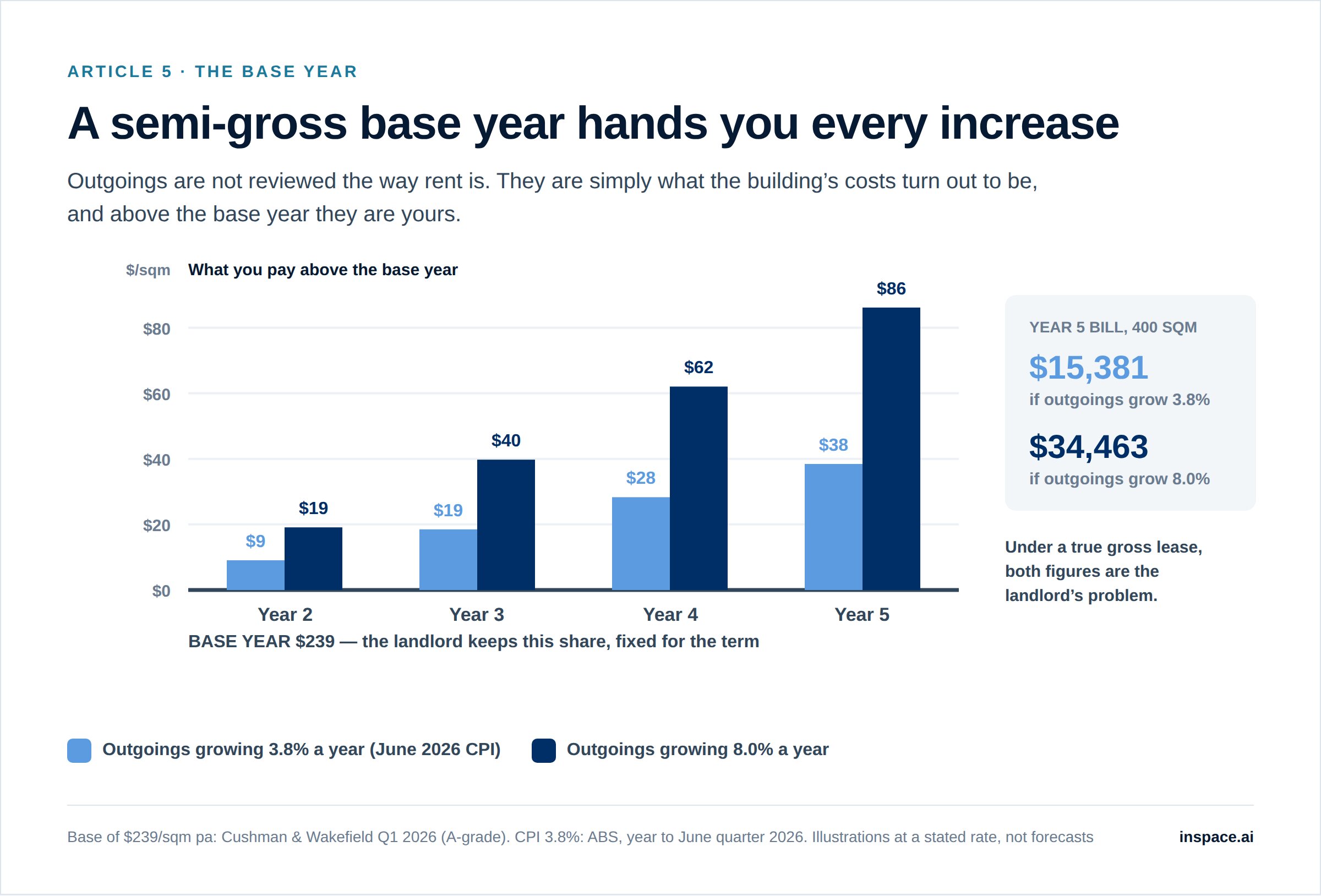
Under a true gross lease, both of those numbers are the landlord’s problem. Under a net lease, all of the $301 or $325 is yours. Under a base year, you pay the difference. None of the three is wrong. But you should know which one you have signed before you build the budget.
How to compare a gross quote against a net quote
This is the part nobody does properly, and it is where the money is.
You cannot compare $450 per square metre gross against $380 per square metre net. They are different units. Converting takes three steps, and skipping any of them can reverse the answer.
Step one: put both on a gross basis. Add the estimated outgoings to the net quote. If Space B is $380 net with outgoings estimated at $95, its gross equivalent is $475. Space A at $450 gross is now the cheaper of the two, by $25 per square metre, when it looked $70 more expensive.
On 400 square metres, that is the difference between believing you will save $28,000 a year and actually spending $10,000 more. A swing of $38,000.
Step two: check both are measured the same way. Rent is a rate multiplied by an area, so an inflated area inflates the bill even when the rate looks fine. If Space B is quoted at 400 square metres but the net lettable area under the Property Council’s method of measurement is 377, you are paying $190,000 for 377 usable square metres, which is $504 per square metre on the space you can actually use. Our guide to net lettable area explains what should and should not be inside that number.
Step three: convert face rent to effective rent. Incentives are large in the current Sydney market. Cushman & Wakefield put average gross incentives at 36.8% for A-grade space in the first quarter of 2026, and published a prime net effective rent of $820 per square metre against a prime net face of $1,427. If Space A comes with three months rent free on a three year term and Space B comes with none, Space A’s effective rent is $412.50 per square metre against Space B’s $475.
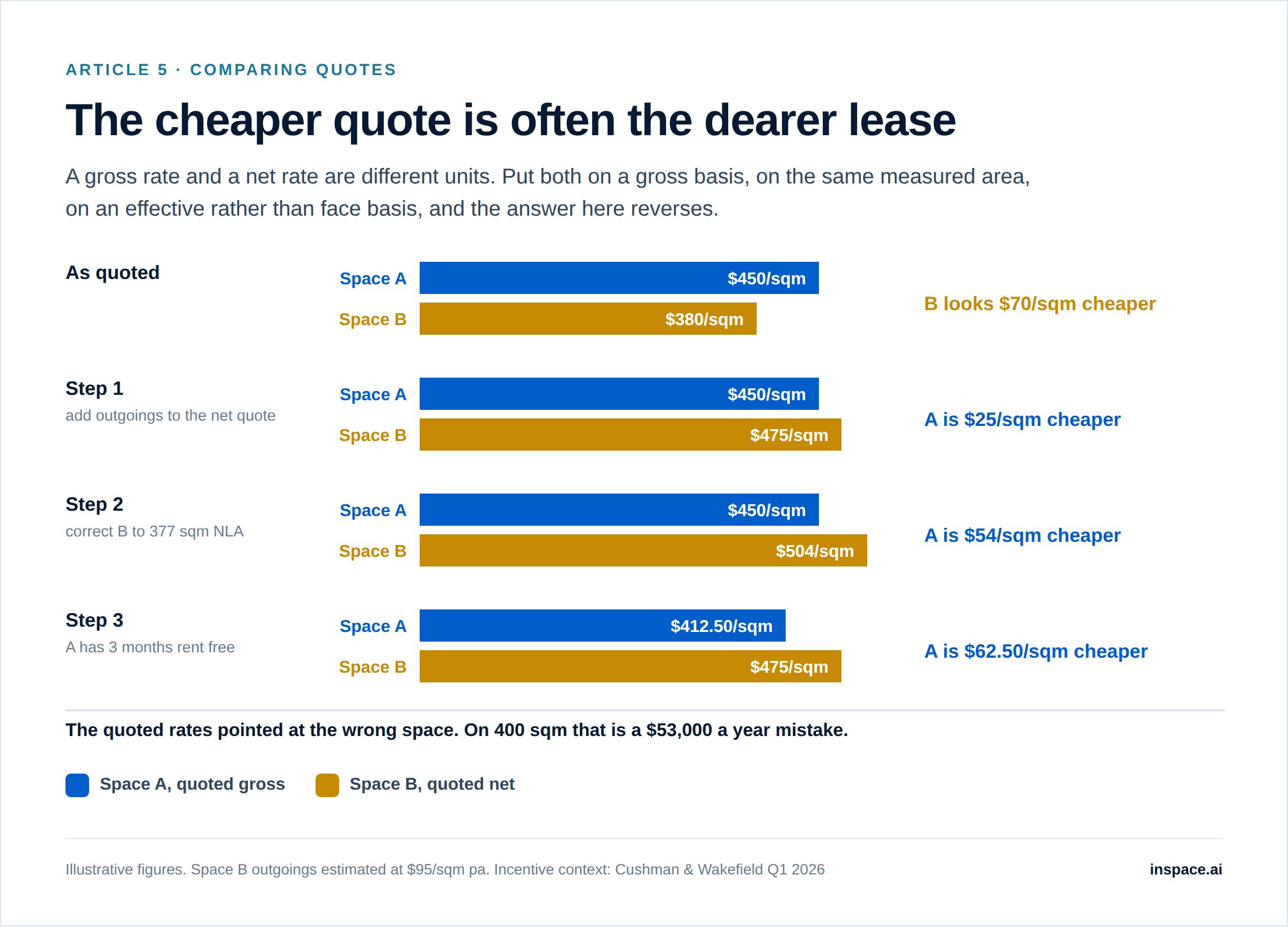
The quoted numbers said Space B was $70 per square metre cheaper. Corrected, Space A is $62.50 cheaper. On 400 square metres that is a $53,000 a year error in the wrong direction, and every step of it comes from comparing figures that were never on the same basis.
The words gross, net and semi-gross do not appear in the law
This surprised us, and it is worth stating plainly, because it explains why the terminology is so loose.
We checked five Australian government leasing resources for the terms “gross lease”, “net lease”, “gross rent”, “net rent” and “semi-gross”:
- The NSW Small Business Commission’s glossary of commercial lease terms
- The NSW Small Business Commission’s guidance on the costs of leasing
- The NSW Retail Tenancy Guide 2022
- Western Australia’s Small Business Development Corporation guide to understanding commercial leases
- The Queensland Small Business Commissioner’s factsheet on entering a commercial lease
None of them use any of those terms. Every one of them discusses rent and outgoings at length, as separate things. Not one names the structures that the entire market negotiates in.
The structures are pure market convention. That is not a scandal, but it does mean there is no statutory definition to fall back on when a landlord’s idea of “gross” differs from yours. The lease document is the only authority, which is exactly why the outgoings clause matters more than the label.
You will also see American terms in Australian search results. “Triple net” and “modified gross” are North American conventions. A modified gross lease is broadly what Australia calls semi-gross. Triple net does appear here, mostly in long-lease investment stock such as service stations and childcare centres, but it is not how a standard office or retail tenancy is described locally.
What the law does control
Plenty, and all of it on the outgoings side.
Outgoings have to be disclosed to be recoverable. In NSW, the Small Business Commission states that under the Retail Leases Act 1994 outgoings must be “meaningfully disclosed”, “directly and reasonably related to the shop that is leased” and “related to the management, operation, maintenance or repair of the building or shopping centre”.
In Victoria, no estimate means no outgoings. The Victorian Small Business Commission says a tenant is only liable for outgoings detailed in the lease under section 39 of the Retail Leases Act 2003, and that “the tenant is not required to pay for outgoings if an estimate has not been given”. A VCAT decision the Commission reported on, Phillips v Abel [2019] VCAT 1031, applied exactly that, with the tribunal finding it would be unfair to let a landlord retrospectively claim outgoings that accrued before the estimate was given.
There is a timetable, and it is specific. For NSW retail leases the Retail Tenancy Guide sets out three dates: by 31 May the lessor provides an estimate for the coming accounting period, by 30 September an audited written statement of the previous period’s outgoings, and by 31 October the parties settle any under or over-payment. Victoria requires estimates before the lease starts and at least a month before each accounting period, with audited statements within three months of the period ending.
Land tax is where the states genuinely diverge. The Victorian Small Business Commission states that section 50 of the Retail Leases Act 2003 prevents a landlord passing land tax to a retail tenant, and its report on Phillips v Abel puts it as “the Act also states a tenant doesn’t have to pay land tax”. The NSW Small Business Commission takes the opposite starting point, describing land tax as “a type of ‘outgoing’ expense that a lessor may pass on to their lessee who has a lease covered by the Retail Leases Act 1994”, while noting the Act limits that ability and that the amount and its calculation should be set out in both the lease and the disclosure statement.
Land tax is often the largest single outgoing. If you are comparing a net lease in Melbourne against a net lease in Sydney, that difference is not a detail.
All of this is retail law. Which brings up the distinction that decides whether any of it applies to you.
Retail or non-retail: it changes your protections, not your rent structure
Australian states each run a retail leases act, and those acts carry the disclosure rules, the outgoings timetable, the minimum terms and the dispute resolution. A non-retail commercial property lease, including most office and industrial tenancies, is governed largely by the lease itself and general contract law.
Most jurisdictions bring premises in by use and by size, with a floor area threshold commonly at 1,000 square metres, and South Australia instead using a rent threshold. Whether a particular tenancy is covered turns on the act, the permitted use and the size, so it is a question for a lawyer.
The point for this guide is that the two things are independent. Gross, semi-gross and net are used across retail and non-retail leases alike. The statutory protections around outgoings are not. A non-retail office tenant on a net lease has whatever reconciliation rights the lease gives them, and no more.
The terms that decide the deal after the rent
Rent structure is one line of a negotiation with about ten that matter. These are settled commercially, usually in a heads of agreement, well before a lawyer drafts anything. Our guide to heads of agreement covers that window and what closes with it.
Two things that trip up first-time tenants
GST is on top. Commercial rent is a taxable supply. The ATO states that if you are registered, or required to be registered, for GST, “you’re liable for GST on the rent you charge on commercial premises”, and that a registered tenant “may be able to claim GST credits for the GST included in the rent”. The Victorian Small Business Commission adds that GST applies to outgoings as well as rent, and that a lease should say whether its figures are inclusive or exclusive. Almost all commercial rents are quoted exclusive. Get it written down.
Longer leases usually get registered. In Queensland a lease of three years or less, including options, is protected under section 185(b) of the Land Title Act 1994, while one running longer than that can be registered with Titles Queensland. Registration protects your interest if the landlord sells or loses possession. Other states run comparable systems with their own thresholds.
So which structure should you want?
There is no correct answer, but there is a way to decide.
Prefer gross if you need budget certainty above all, if you are a small tenant without the resources to audit a reconciliation statement, if the building is older or lower grade where outgoings are a big share of the bill, or if the term is short.
Prefer net if you want the lowest headline rent, if you have the capacity to check the numbers, if you are large enough to negotiate caps and exclusions on individual outgoings, and if you believe the building is well run.
You will probably get semi-gross, because that is the Australian market default. If you do, the base year figure is the number to negotiate. A base year set at an artificially low figure, or at a year when the building was half empty, hands you increases that have nothing to do with cost inflation.
Whatever the structure, the discipline is the same. Convert everything to one basis before you compare. Gross, on the same measured area, on an effective rather than face basis. Then the numbers mean something.
Comparing spaces on a common basis
The reason lease comparisons go wrong is rarely arithmetic. It is that the information arrives in different shapes. One agent sends a gross rate in a PDF, another sends a net rate plus an outgoings estimate in an email, a third sends a brochure with an area that includes a loading nobody mentioned. Then you are asked to decide.
Inspace puts an asset into a single interactive model where floor plates, tenancy areas, availability and asset data all sit in one place, so a prospective tenant sees the same defined space and the same numbers that the leasing team does. It is used across more than $190 billion of real estate, identifies anonymous viewers with 90% accuracy, and helps close deals up to 31% faster.
Request a Demo to see how your building would present.
Frequently asked questions
What is a commercial lease?
A commercial lease is a binding agreement under which a landlord grants a business the right to occupy premises for a fixed term in return for rent. It sets out the rent and how it is reviewed, who pays the property’s outgoings, what the tenant may use the space for, the condition it must be returned in, and what security the landlord holds. Commercial leases are distinguished from residential leases, and in each Australian state retail premises are also covered by a retail leases act that adds disclosure and outgoings protections.
What does gross mean in a lease?
Under a gross lease the tenant pays a single rent figure and the landlord meets the property’s outgoings, such as rates, water, insurance, cleaning and common area costs. The tenant’s cost is fixed and predictable. In practice most Australian leases described as gross are semi-gross, meaning outgoings are included only up to a base year and the tenant pays increases above it. Check the outgoings clause rather than the label.
What is the difference between a gross and a semi-gross lease?
A gross lease includes all outgoings in the rent for the whole term, so cost increases sit with the landlord. A semi-gross lease includes outgoings only to a base figure, usually the first year, and the tenant pays any increase above that base. A second version of semi-gross has the tenant pay rent plus specific named outgoings and nothing else. Both leave the tenant carrying some cost growth that a true gross lease would not.
Why is it called a net lease?
Because the rent figure is net of outgoings. The landlord receives that amount clear of the property’s running costs, because the tenant pays those separately. A net rent is therefore always lower than the gross rent for the same space, by roughly the cost of outgoings, and the difference is not a saving.
What are the drawbacks of a net lease?
The tenant carries cost growth. Outgoings are not reviewed the way rent is, so they rise at whatever the building’s actual costs do. In the year to June 2026 Australian headline CPI was 3.8% while electricity was 22.4% higher, and utilities are an outgoing. A net lease also creates administration: estimates, annual statements and a reconciliation to check. And the low headline rent makes a net quote look cheaper than a gross quote for the same building when it is not.
Does gross rent include GST?
No. Commercial rents in Australia are almost always quoted exclusive of GST, and GST is added to both rent and outgoings where the landlord is registered. A tenant registered for GST can generally claim the GST back as a credit, so it is a cash flow issue rather than a cost. The lease should state whether the figures in it are inclusive or exclusive, and you should confirm which before signing.
Does gross rent include outgoings?
In a fully gross lease, yes, that is the point of it. In a semi-gross lease, outgoings are included only up to a base year figure and increases above that are charged to the tenant. Because many leases marketed as gross are actually semi-gross, the reliable test is to ask whether there is a base year and what the base figure is. If there is one, the lease is semi-gross.
How do I compare a gross rent to a net rent?
Put both on the same basis before you compare anything. First add the estimated outgoings to the net quote to get its gross equivalent. Second, check both quotes use the same measured area, because rent is a rate times an area and a loaded area inflates the bill. Third, convert face rent to effective rent by spreading any rent free period or incentive across the term. A quote that appears cheaper on the headline rate frequently is not once all three corrections are made.
What are the main types of commercial lease in Australia?
By rent structure there are three: gross, semi-gross and net. By the law that applies there are two: retail leases, which are covered by a state retail leases act and its disclosure and outgoings rules, and non-retail commercial leases such as most office and industrial tenancies, which are governed largely by the lease itself. A tenancy has both a rent structure and a legal category, and they are independent of each other.
Who pays outgoings on a commercial lease?
It depends on the structure agreed. Under a gross lease the landlord does. Under a net lease the tenant pays a share of them on top of the rent. Under a semi-gross lease the landlord pays them to a base figure and the tenant pays increases above it. For retail premises the relevant state act restricts what can be recovered and requires estimates and audited statements, and in Victoria a landlord cannot pass on land tax at all.
What is the best lease structure for a commercial property?
It depends on which side you are on and how much cost certainty you need. Gross suits tenants who want a fixed, predictable figure and who lack the resources to audit an outgoings reconciliation, and it matters more in lower grade buildings where outgoings are a larger share of the total. Net suits tenants who want the lowest base rent and can negotiate caps on individual outgoings, and it suits landlords who want income insulated from cost growth. Semi-gross is the Australian default and the base year figure is the number to negotiate.
How much does a commercial lease cost beyond the rent?
Outgoings are the main additional cost. Cushman & Wakefield’s Sydney CBD data for the first quarter of 2026 puts them at $239 per square metre a year for A-grade office space, which is 15.3% of the gross rent, rising to 18.3% of the total in secondary buildings. On top of that sit fit-out costs, GST, legal fees, a bank guarantee that ties up your banking facility for the term, and a make good obligation at the end that is frequently not priced until it arrives.

%201.svg)