
How to Value Commercial Property in Australia: Methods & Worked Examples
August 28, 2026
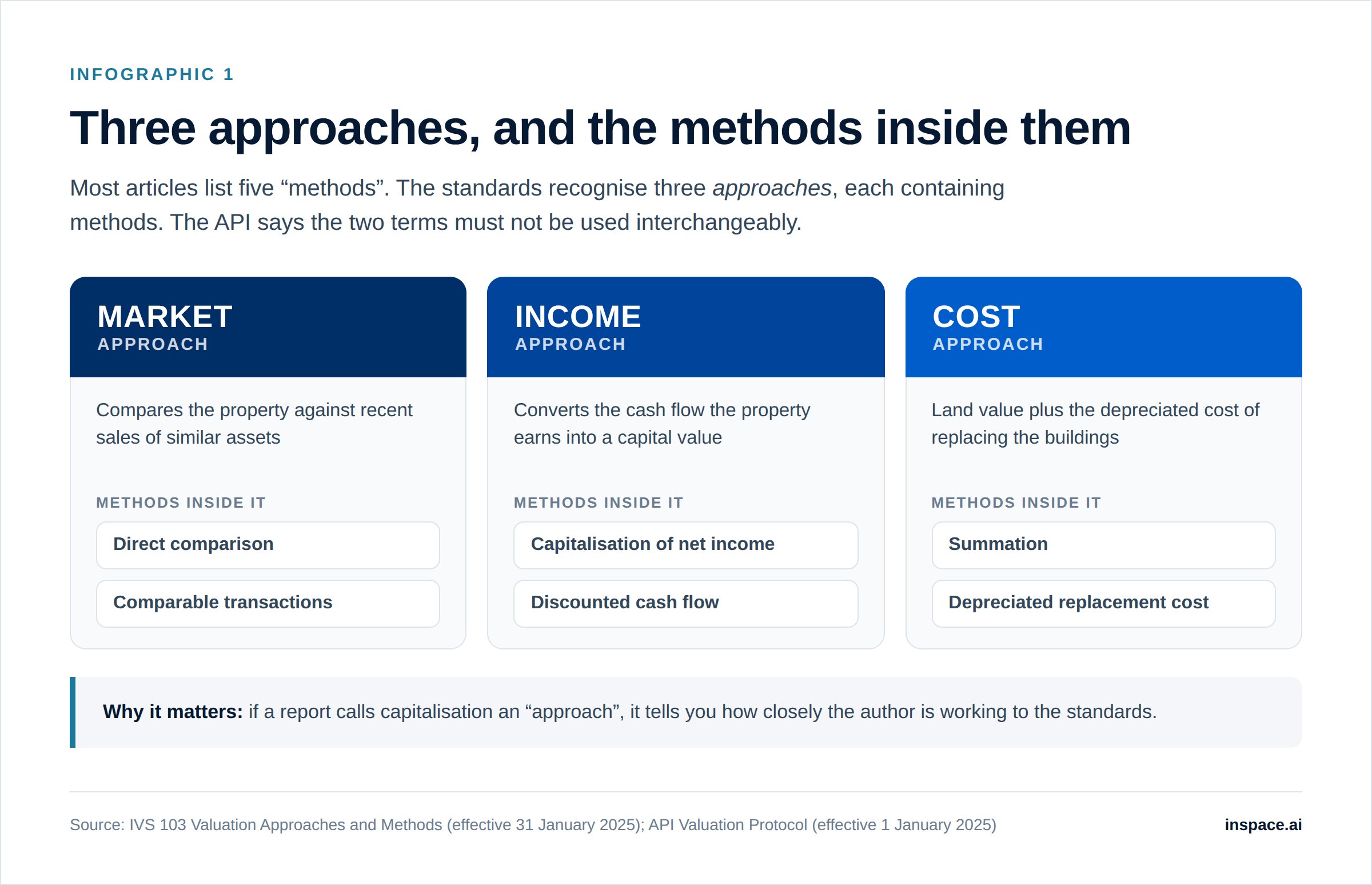
A commercial property valuation uses three approaches: the market approach, which compares the property against recent sales; the income approach, which converts the rent it earns into a capital value; and the cost approach, which adds land value to the depreciated cost of the buildings. For a tenanted asset the working formula is net operating income divided by the market yield.
That is the short answer. The long answer matters because the same building can carry two valuations several million dollars apart depending on the yield applied to it, and almost nobody outside the profession understands why.
This guide covers how to value commercial property using all three approaches, with real numbers and current Australian market data. Then the things owners actually get caught by: why the bank's figure came back low, who is legally allowed to value, what it costs, and why you usually cannot reuse the valuation you already paid for.
Why there is no free online estimate for commercial property
If you own a house, four websites will value it in ten seconds. If you own a warehouse, none of them will. Residential estimates work because houses in a suburb are broadly comparable and sell often, so there is enough repeat data to model. Commercial property has neither. Two warehouses on the same street can differ in value by half, because one has a national tenant on a ten year lease and the other is vacant with a leaking roof.
The building is only part of the asset. The lease is the rest of it, and the value sits in documents rather than bricks: the review structure, the outgoings recovery, the tenant's covenant, the remaining term. No algorithm reads those from a satellite photo. You can still reach a defensible ballpark yourself if you know your net income and the yield your sector trades at, but a figure a bank, a court or the ATO will accept is another matter.
How to value commercial property: approaches vs methods
Most articles list "five valuation methods": capitalisation, direct comparison, summation, discounted cash flow and residual development. That is not wrong, but it flattens a distinction the standards are strict about.
Under IVS 103 Valuation Approaches and Methods, in the International Valuation Standards effective 31 January 2025, there are exactly three approaches:
- the market approach, which "provides an indication of value by comparing the asset and/or liability with identical or comparable" assets
- the income approach, which "provides an indication of value by converting projected cash flows to a single current value"
- the cost approach, on the principle that a buyer "will pay no more for an asset than the cost to obtain an asset of equal utility"
Everything else is a method inside one of those three. Capitalisation and discounted cash flow are methods within the income approach. Direct comparison sits within the market approach. Summation sits within the cost approach.
The Australian Property Institute's Valuation Protocol: Valuation Approaches and Methods, effective 1 January 2025, adopts those three approaches and states that members must not use "approaches" and "methods" interchangeably in reports.
One thing to watch in older material: the API retired its Australia and New Zealand Valuation and Property Standards on 1 July 2021 and now adopts the international standards with Guidance Papers on top. Anything citing ANZRPGN guidance notes as current is working from a framework abandoned five years ago.
The market approach: direct comparison
This asks what buyers have actually paid for similar assets, then adjusts for the differences. The usual unit of comparison is the rate per square metre of net lettable area.
If you are not confident in the NLA figure you have been given, resolve that first, because every rate per square metre in a valuation is built on it. Our guide to net lettable area covers how it is measured and where it goes wrong.
Take a 1,800 square metre A-grade office asset:
The adjusted evidence brackets tightly, from $20,550 to $20,890 per square metre. Adopt $20,770:
1,800 sqm × $20,770 = $37,390,000
Two things make or break this. Whether the comparables are genuinely comparable, which in thin markets they often are not. And the adjustments, which are judgement calls and where two competent valuers most often part company. A valuer who cannot explain each adjustment is guessing with a spreadsheet. The comparables above are illustrative; real ones come from settled sales evidence, and recency matters enormously.
The income approach: capitalisation of net income
This is the workhorse for anything tenanted. An investment is worth what its income stream is worth, and the market sets the multiple.
Value = net operating income ÷ market yield
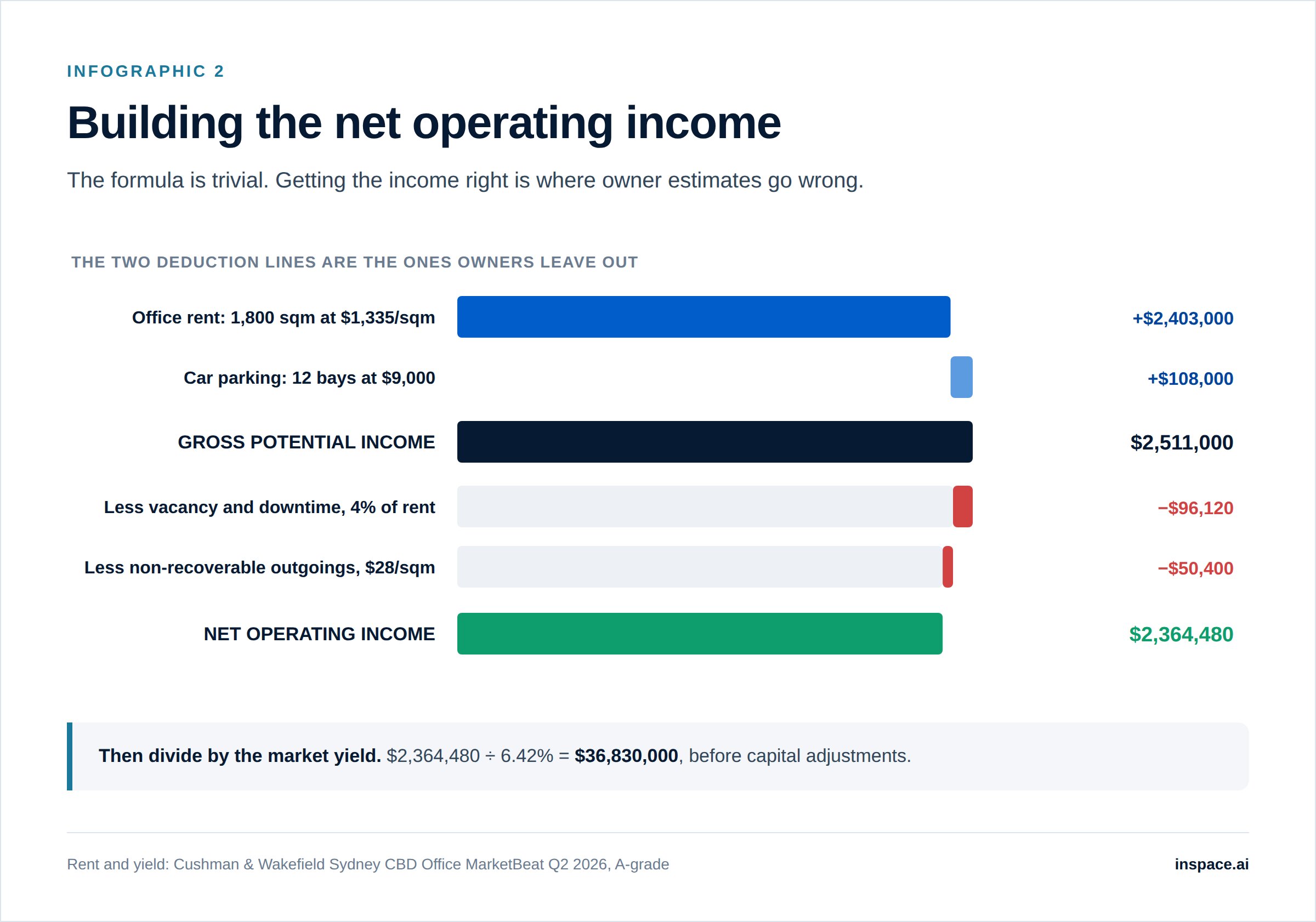
The formula is trivial. Building the net operating income is not, and it is where owner estimates go wrong.
Step one: build the net operating income
The rent is Cushman & Wakefield's Q2 2026 figure for Sydney CBD A-grade net face rent. Two lines are the ones owners leave out.
Vacancy and downtime. Even a fully leased building has empty months between tenants. A valuation reflects that; mental arithmetic usually does not.
Non-recoverable outgoings. In a net lease the tenant pays outgoings, which is why we start from net face rent. But not everything is recoverable. Land tax is not recoverable in some states, management costs are often partly borne by the owner, and capital items never are. Whatever the landlord absorbs comes off the income.
Step two: capitalise it
Divide by the market yield. Cushman & Wakefield put the Sydney CBD A-grade market yield at 6.42% in Q2 2026:
$2,364,480 ÷ 6.42% = $36,830,000
Step three: the capital adjustments nobody mentions
A capitalised figure is a starting point, not an answer. Valuers then adjust for capital items the income stream does not capture:
- Outstanding incentive liabilities. Sydney CBD A-grade incentives were running at 37.0% of gross rent in Q2 2026. A tenant signed on a large incentive still being amortised is a real obligation, and it comes off value.
- Committed or overdue capital expenditure. A lift replacement due next year is a cost the buyer inherits.
- Letting up costs on vacant space: agent fees, incentives, and rent forgone.
- Rental reversion, where passing rent sits above or below market. Over-rented income is worth less than it looks, because it falls at review.
Apply a $420,000 outstanding incentive liability and $250,000 of committed lift capex:
$36,830,000 − $670,000 = $36,160,000, about $20,089 per square metre.
That is a 1.8% adjustment here. On a building with heavy incentive obligations and a tired plant room it can run past 10%, and it is the most common reason an owner's expectation and a valuer's figure diverge.
The yield matters more than anything else you control
Hold the income perfectly still and change only the yield:
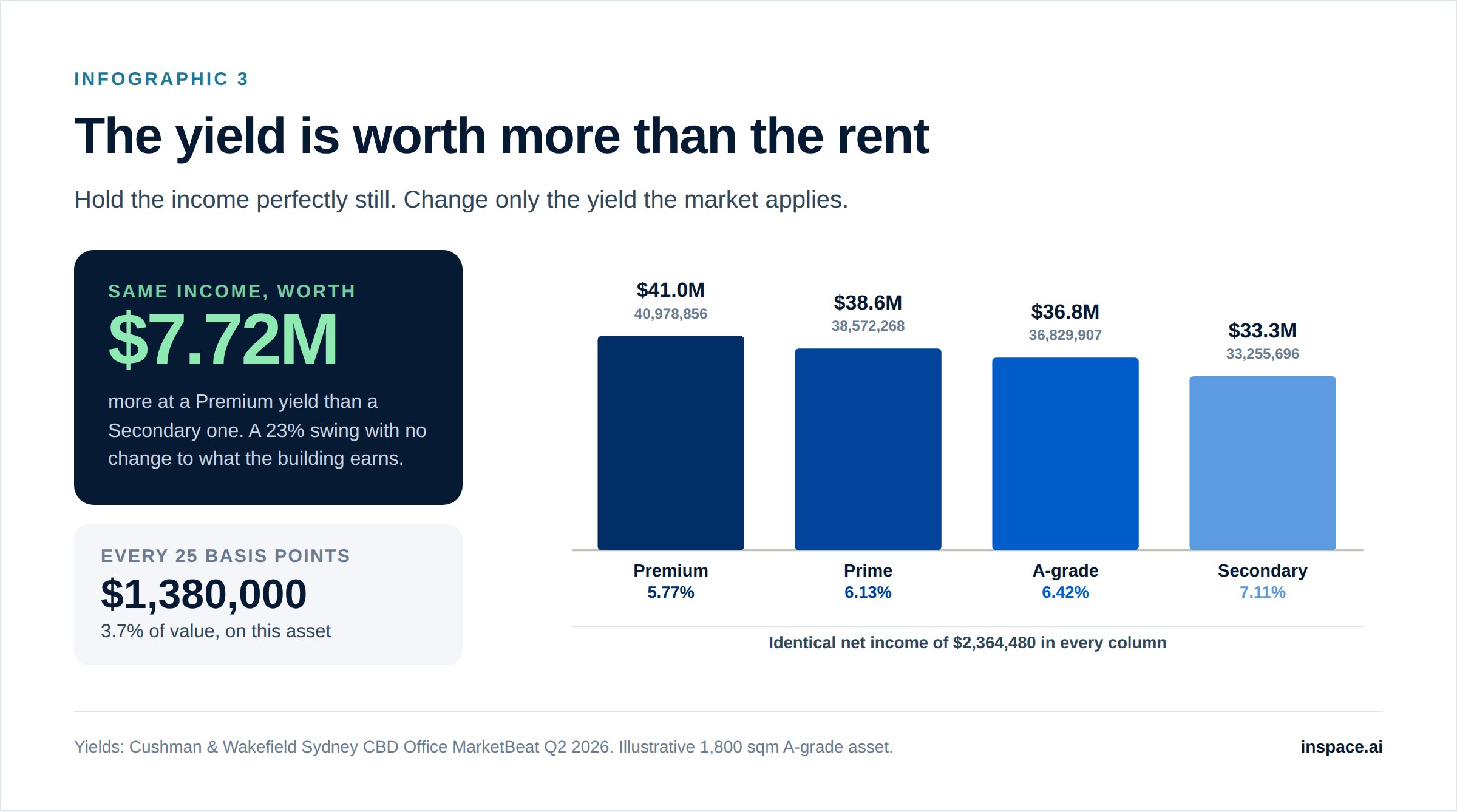
The same $2,364,480 of net income is worth $7,723,160 more at a Premium yield than a Secondary one. A 23% swing, driven entirely by how the market grades the asset rather than what it earns.
At a practical scale, every 25 basis point movement is worth about $1,380,000 on this asset, or 3.7% of value. Fifty basis points is $2,661,120. A full percentage point is $4,963,599.
Which reframes what creates value. Chasing another $20 per square metre of rent is worth something. Moving the asset from a secondary yield to a prime one, by improving the tenant covenant, lengthening the lease profile, clearing the capex backlog and presenting the asset properly to institutional buyers, is worth far more. A yield is the market's judgement about risk, and risk is manageable. How yields are derived, and how they differ from returns, is a subject of its own; we will cover cap rates separately.
The other income method: discounted cash flow
Capitalisation treats income as a stable perpetual stream. When it clearly is not, valuers use discounted cash flow instead, projecting actual cash flows year by year over about a decade, discounting them to present value and adding a discounted terminal value for the eventual sale. It suits a lumpy income profile: a major lease expiring in year three, a staged refurbishment, fixed uplifts that differ from market growth.
The catch is that a DCF needs a discount rate, a terminal yield, rental growth, incentive, downtime and capex assumptions, every one of them arguable and compounding over ten years. Used carelessly it produces whatever number the author wanted, which is why valuers run it alongside capitalisation rather than instead of it.
The cost approach: summation
Value the land, add the depreciated cost of replacing the improvements, total the two.
Note how far that sits from the other two. Income said $36.8 million, direct comparison said $37.4 million, summation says $25.5 million: roughly 31% lower. That is the method's nature rather than an error, because the cost approach ignores income and the scarcity value of location, so it reliably understates well-let investment property. It earns its place where the others cannot work: special purpose assets with no sales evidence and no market rent, such as a purpose-built church or a wastewater plant. On an ordinary tenanted building it is a cross-check at best.
How a valuer lands on one number
Three approaches produce three answers, and reconciling them is part of the job. ANZVGP 111 Valuation Procedures – Real Property, effective 1 January 2025, requires that methodology "should be appropriately outlined for each valuation approach along with calculations and rationale" and that "a reconciliation of the approaches adopted should be included."
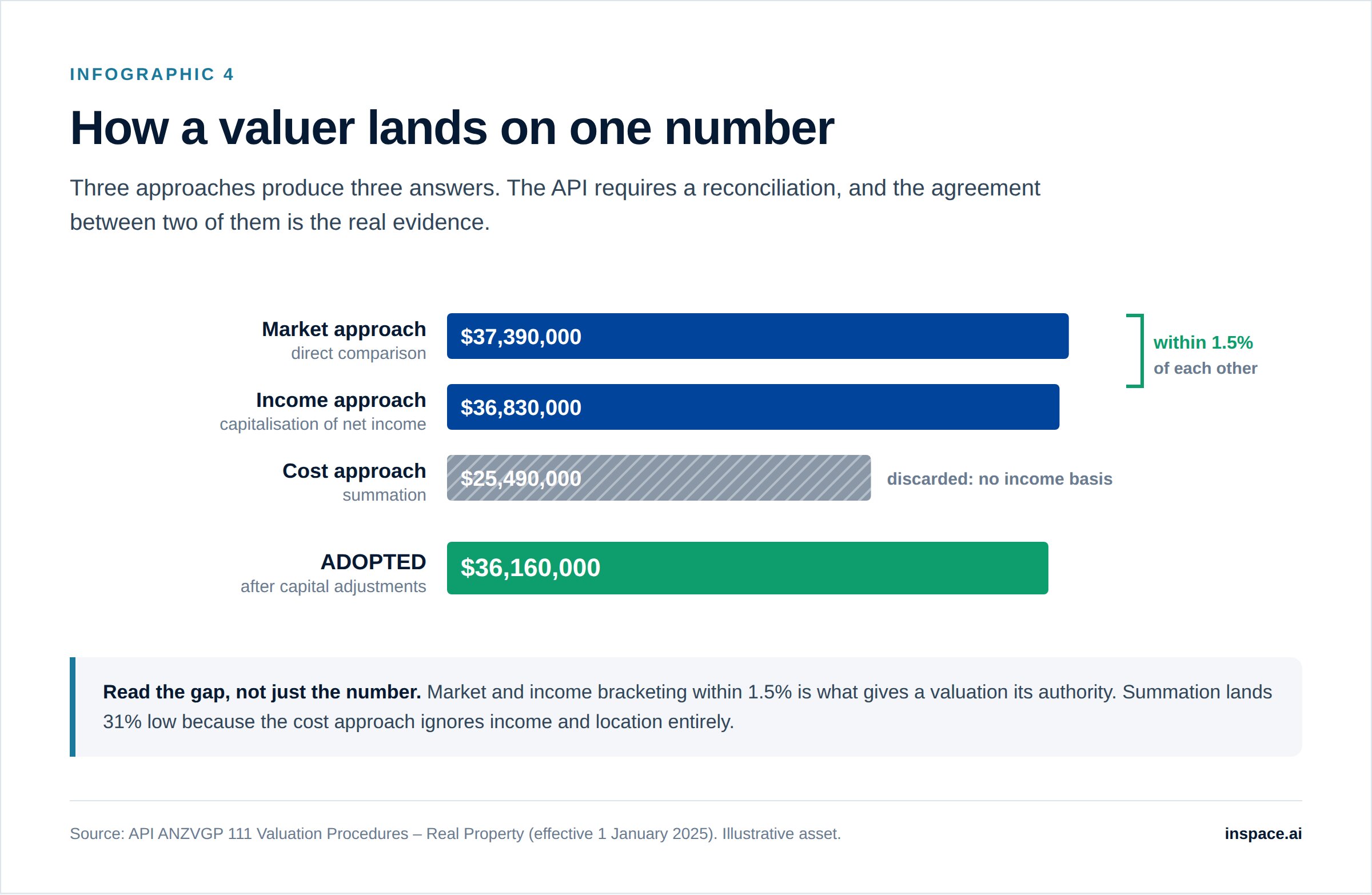
Market and income bracket each other within 1.5%, and that agreement is the real evidence. Summation is discarded as inapplicable to an income-producing asset. A commercial property valuation that leans on one approach with no cross-check is a weaker document, whatever number it reaches.
Where valuations are being written right now
Market data in this section is Q2 2026 and early August 2026. Everything above is method and does not date.
Australian commercial property is being valued in a tightening environment for the first time in years. The Reserve Bank held the cash rate at 4.35% on 11 August 2026, after three increases earlier in 2026, saying headline inflation "is still too high" and is not expected back at the target midpoint until late 2027.
Bond yields moved with it. Cushman & Wakefield's Q2 2026 research printed the Australian 10-year Treasury yield at 4.8%, consistent with an OECD monthly figure of 4.83% for June. By 11 August it had crossed above 5%. Since bond yields are the reference point for property yields, the direction matters.
What has not happened is a yield blowout. CBRE's Q2 2026 research found "prime yields were mostly stable across Australian CBD markets", because "rental growth is typically outperforming expectations which is justifying stable yields." Cushman & Wakefield agreed for Sydney, adding that "higher funding costs and leasing risk continue to limit near-term yield compression." Stable, then, but not compressing. Transaction volumes agree: $16.2 billion in Q2 2026, up 70% on the previous quarter and 38% year on year.
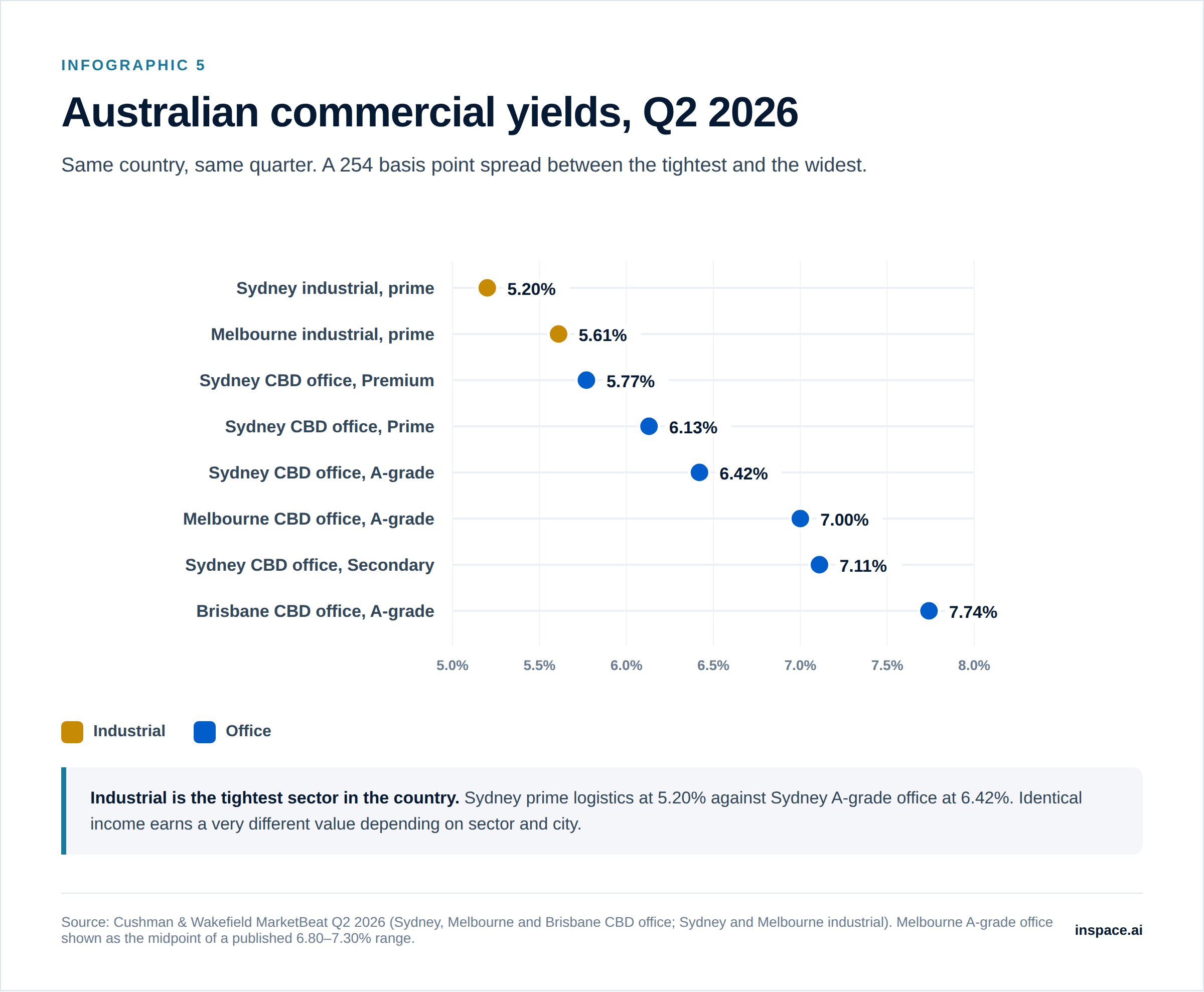
Current benchmarks, all Q2 2026:
Industrial remains the tightest sector, with Sydney prime logistics at 5.20% against Sydney A-grade office at 6.42%. Office pricing also varies far more by city than owners assume: identical income earns a materially different value in Brisbane than in Sydney. Vacancy is the pressure point, at 13.8% for the Sydney CBD overall, 16.6% for A-grade, and 19.0% in Melbourne.
Why the bank's valuation came back low
This surprises owner-occupiers constantly, and the reason is written into the standards.
The API's ANZVGP 112 Valuations for Mortgage and Loan Security Purposes, effective 1 January 2025, directs that "owner-occupied property (which includes related entity occupied property) should be valued on a vacant possession basis (unless otherwise instructed)."
Read that again if you occupy your own premises. There is no lease to an unrelated party, so there is no income to capitalise, and the property is assessed as an empty building rather than the income-producing asset you experience it to be. That is usually a lower number, sometimes considerably lower.
Three other things worth knowing:
- You do not choose the valuer, and you pay anyway. Under APRA's prudential standard APS 220, valuations must be "appraised independently from the ADI's credit origination, credit assessment and approval process." Banks work from panels. ANZ's published process has the bank engaging the valuer while the client pays the fee.
- The report is addressed to the bank, not you. The Australian Banking Association's industry guideline states the valuation "is addressed to the bank and the bank provides a copy to the customer on a non-reliance basis."
- It can be slow. ANZ notes panel commercial valuations can take "more than 40 days to complete."
Who can legally value property in Australia
Australians use "valuation" and "appraisal" interchangeably. Legally they are different documents, and in some states producing one when you are qualified only for the other is an offence. A valuation is a formal assessment by a qualified valuer; a market appraisal is an agent's estimate of likely selling price. The Valuers Registration Board of Queensland is blunt: an appraisal "is not a property valuation and cannot be relied upon as a basis for a financial decision, legal or statutory requirement."
Regulation differs by jurisdiction, which defeats national assumptions:
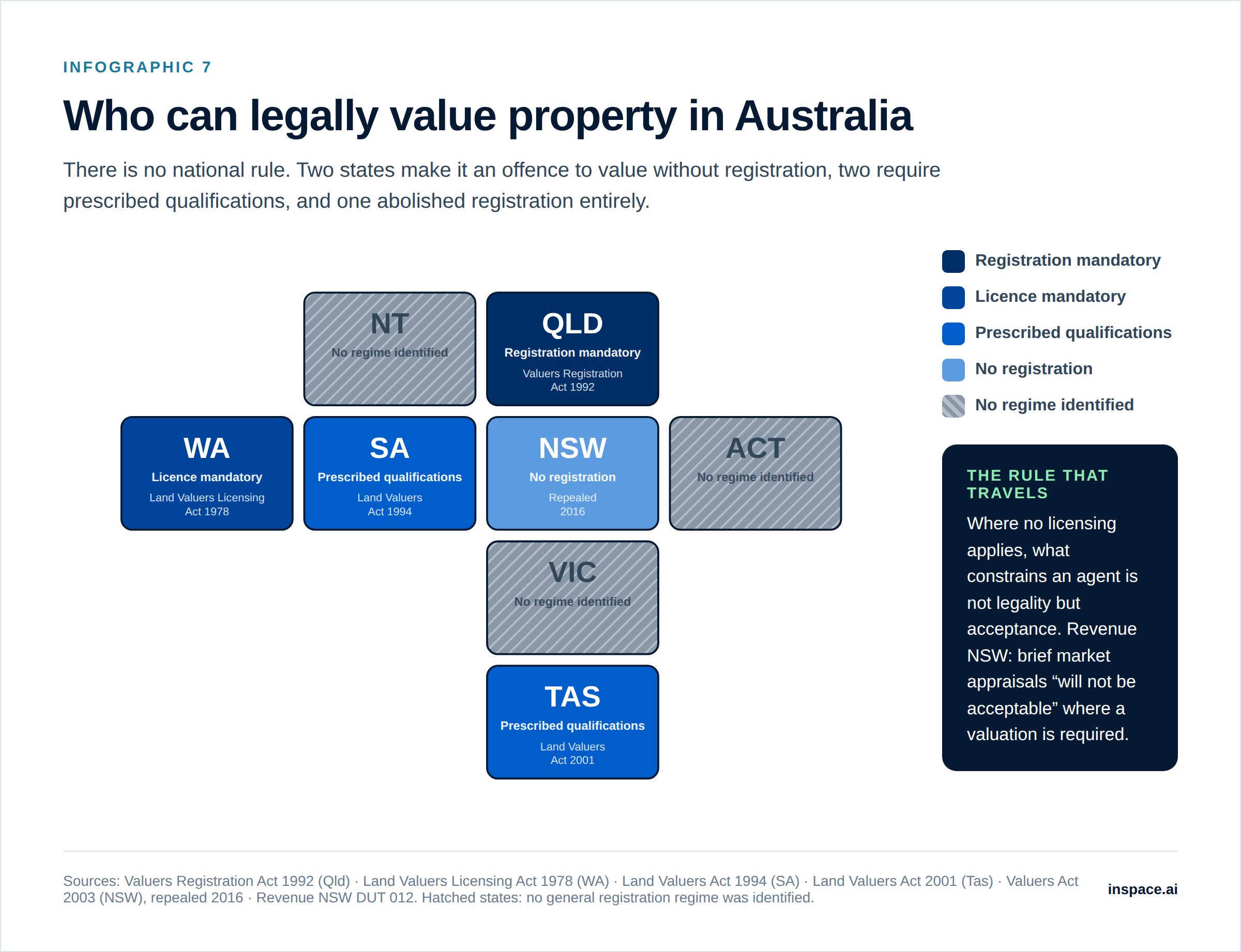
In New South Wales there is no equivalent offence, so what constrains an agent there is not legality but acceptance. And acceptance is where it bites. Revenue NSW's evidence of value ruling states that "brief market appraisals, estimates of value or other statements that do not indicate a full inspection of the subject property has been undertaken will not be acceptable." Its list of suitably qualified people covers members of the Australian Property Institute, the Australian Valuers Institute, and RICS holders of MRICS or FRICS. Real estate agents are not on it.
The credential to look for is Certified Practising Valuer, awarded by the API on completion of an accredited course, the Practical Valuation Training program, and at least two years of real property valuation experience within the past four. Note the API also issues a narrower CPV (Residential), which cannot be used for a commercial asset.
The valuation you have is probably not the one you need
Valuations are purpose-specific, and one prepared for a given use frequently cannot be recycled.
What a commercial property valuation costs, and how long it takes
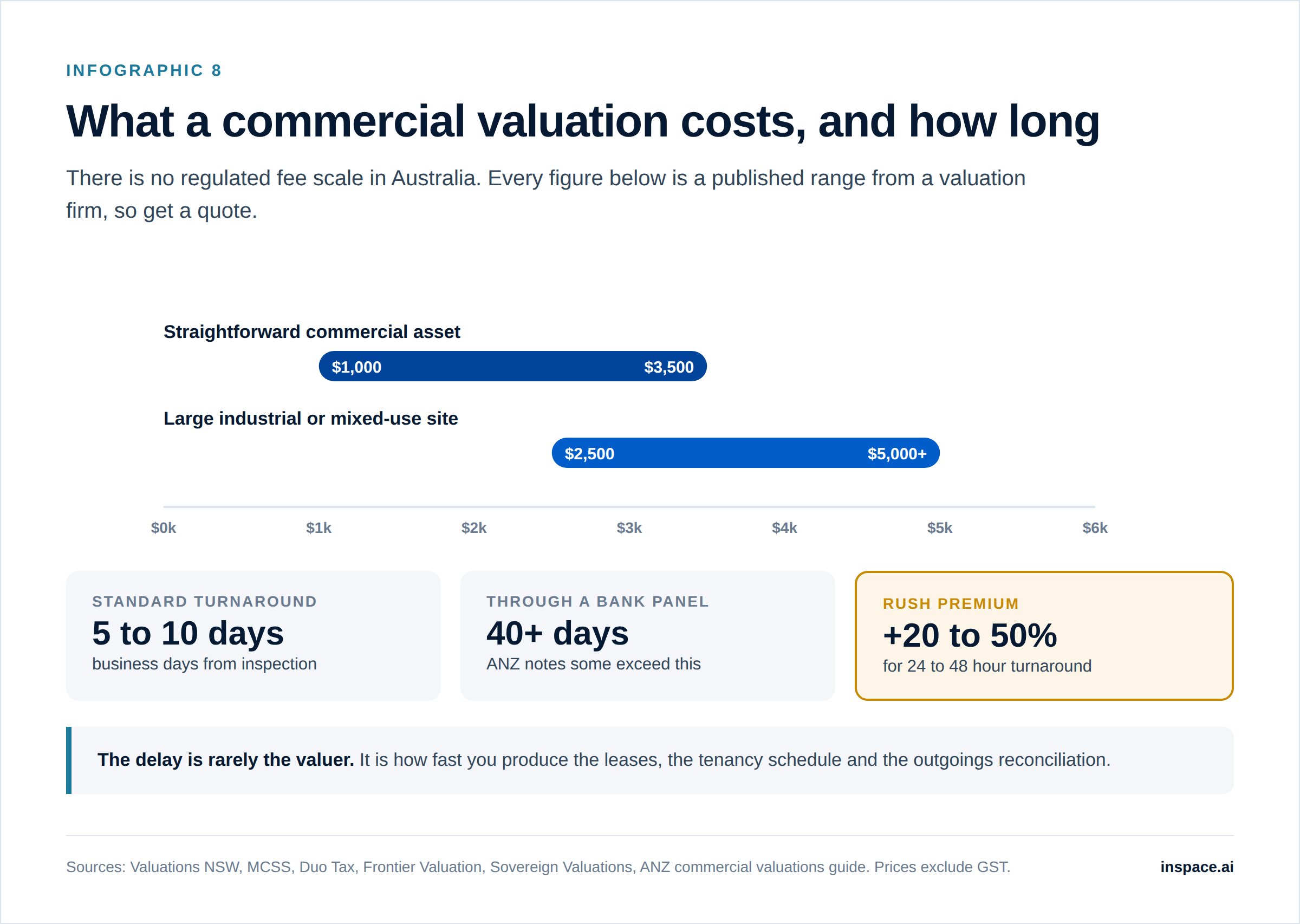
There is no regulated fee scale in Australia, and Consumer Protection WA notes valuers set their own fees. The figures below come from valuation firms' published guidance, so treat them as indicative and get a quote.
For a straightforward commercial asset, published ranges converge on roughly $1,000 to $3,500 plus GST. Valuations NSW quotes $900 to $3,000 excluding GST. MCSS puts a small strata office or retail suite around $1,500 and a large industrial or mixed-use site at $2,500 to $3,500 or more. Duo Tax and Frontier Valuation both publish $1,000 to $5,000 or more. Complex or specialised assets run past $5,000.
What moves the price: property type, size and complexity, location and travel, and above all purpose. A valuation for court, a family law matter or an ATO submission needs far more detail than a basic market assessment. Urgency costs too, with Valuations NSW noting a 24 to 48 hour turnaround can add 20% to 50%.
Commercial valuations are effectively always long form. The short form report exists mainly for residential mortgage work, and the API's PropertyPRO pro-forma is residential only. There is no commercial equivalent, which is much of why commercial costs several times residential.
Expect five to ten business days from inspection, and about two weeks for anything complex. The variable is rarely the valuer. It is how fast you produce the leases, the tenancy schedule and the outgoings reconciliation.
SMSF property and the ATO: correcting a common claim
Plenty of firms will tell you the ATO requires an annual independent valuation of property in a self-managed super fund. The ATO says otherwise, in its own words.
Trustees must value all fund assets at market value each year under regulation 8.02B of the Superannuation Industry (Supervision) Regulations 1994. But the ATO's guidance states that "regulation 8.02B of the SISR does not require trustees to obtain an independent valuation from a qualified independent valuer each year."
What it requires is credible evidence, and more than one piece. Acceptable evidence includes an agent's appraisal, a recent contract of sale, comparable sales, a rates notice consistent with other material, and for commercial specifically "the net income yield of commercial properties." The critical line: "it is not sufficient for valuations to be based on only one item of evidence."
An independent valuer is mandatory only in narrow cases involving collectables disposed of to a related party. Otherwise the ATO recommends one "if the value of a fund asset represents a significant proportion of the fund's value", which for an SMSF holding a commercial property it usually is. So the accurate statement is: an annual market value supported by multiple pieces of evidence, with an independent valuer recommended rather than mandated.
How to get a valuation that holds up
The quality of a commercial property valuation depends heavily on what you hand the valuer. Have this ready:
- The executed leases, including variations, side deeds and options.
- A tenancy schedule: area, commencement, expiry, passing rent, review structure, options, and any incentive still amortising.
- Two years of outgoings reconciliations, separating what is recoverable from what the landlord absorbs.
- A certified area survey. Every rate per square metre in the report is built on it.
- Capex history and forward plan, including anything a condition report has flagged.
- Title and planning documents: easements, encumbrances, heritage listing.
- A clear statement of purpose, before the valuer starts, because it sets the basis of value and whether the report will be fit to use.
The fastest way to be disappointed is to hand over a brochure and a rates notice and expect a number you can bank.
Presenting an asset so it earns its yield
Everything in the sensitivity table points one way: how the market grades your asset is worth more than incremental rent. Grading is a judgement about risk, and buyers form it from the information you give them.
That is a presentation problem as much as an asset problem. When a buyer or valuer has to assemble their understanding from a brochure, a separate area schedule, an email with the tenancy details and a site visit they may never take, they price the uncertainty.
Inspace puts the whole asset into one interactive 3D model: floor plates, tenancy areas, virtual tours of the real space, and the data behind them. For owners running a sale or a capital raise, Inspace for Asset Sales turns a static information memorandum into a trackable presentation, so you can see which floors a prospective buyer looked at and for how long. Interested parties are identified with 90% accuracy, and Inspace has been used across more than $190 billion of real estate, including the $550 million sale of Sydney's Queen Victoria Building.
Request a demo to see how your asset would present.
Frequently asked questions
How do you value a commercial property?Commercial property is valued using three approaches: the market approach, comparing recent sales on a rate per square metre basis; the income approach, dividing net operating income by the market yield; and the cost approach, adding land value to the depreciated replacement cost of the buildings. For a tenanted property the income approach usually leads, cross-checked against comparable sales.
What is the formula for valuing commercial property?Value equals net operating income divided by the market yield. Net operating income is gross potential income less a vacancy and downtime allowance and less non-recoverable outgoings. A property earning $2,364,480 net, capitalised at a 6.42% market yield, indicates about $36,830,000 before capital adjustments.
How much does a commercial property valuation cost in Australia?Published ranges from valuation firms sit at roughly $1,000 to $3,500 plus GST for a straightforward asset, rising past $5,000 for large, complex or specialised property. There is no regulated fee scale, so price varies with property type, size, location, purpose and urgency. Rush turnarounds can add 20% to 50%.
How long does a commercial valuation take?Five to ten business days from inspection is typical, and about two weeks for complex assets. Valuations ordered through a bank's panel take longer, with ANZ noting some exceed 40 days. The usual delay is the owner producing leases and outgoings records.
What is the difference between a valuation and an appraisal?A valuation is a formal assessment by a qualified valuer that can be relied on for financial, legal and statutory purposes. An appraisal is an agent's estimate of likely selling price and cannot. In Queensland, producing a valuation without registration contravenes the Valuers Registration Act 1992.
Can a real estate agent value a commercial property?An agent can provide a market appraisal but not a valuation. In Queensland and Western Australia, valuation work without registration or a licence is an offence. Even where no licensing applies, Revenue NSW states brief market appraisals "will not be acceptable" where a valuation is required, and banks work from panels of API or RICS qualified valuers.
Why is my bank's valuation lower than I expected?If you occupy the property yourself, the likely reason is the basis of value. API guidance ANZVGP 112 directs that owner-occupied property be valued on a vacant possession basis unless instructed otherwise, so the valuer assesses an empty building rather than capitalising an income stream.
What is a good yield for commercial property in Australia?It depends on sector, grade and city rather than any universal benchmark. In Q2 2026, Cushman & Wakefield put Sydney CBD Premium office at 5.77% and Secondary at 7.11%, Melbourne CBD A-grade at 6.80% to 7.30%, Brisbane CBD A-grade at 7.74%, and Sydney prime industrial at 5.20%. Lower yields signal lower perceived risk, not a worse investment.
Does the ATO require an annual valuation for SMSF property?The ATO requires trustees to report assets at market value each year, but states the rules do not require an independent valuation from a qualified valuer every year. It does require more than one item of supporting evidence, and recommends an independent valuer where the asset is a significant proportion of the fund's value, which a commercial property usually is.
Can I use my rates notice to value my property?No. A statutory valuation from a state Valuer General is a different basis of value. NSW land value excludes buildings and structural improvements entirely, and Queensland issues site value or unimproved value. These figures drive rates and land tax, not market price.
Who is qualified to value commercial property in Australia?Look for a Certified Practising Valuer with the Australian Property Institute, or a RICS member holding MRICS or FRICS. In Queensland the valuer must also be registered with the Valuers Registration Board of Queensland, and in Western Australia licensed under the Land Valuers Licensing Act 1978. Check that a CPV is not the narrower CPV (Residential), which cannot be used for commercial property.

%201.svg)