

Commercial Real Estate Marketing: Strategies and Ideas That Win Deals
September 20, 2026
Commercial property marketing has one job: get a qualified buyer or tenant to understand an asset well enough to act on it, usually without standing in it.
That is a different job from residential marketing, and most commercial campaigns fail because they borrow residential tactics. A house is sold to someone who will live in it, so the marketing sells a feeling. A commercial asset is sold or leased to someone running a spreadsheet, so the marketing has to survive their analysis.
The market is also doing the work no campaign can fix. Australia’s national office vacancy rate rose from 15.8% to 16.1% over the six months to July 2026, the highest level since the pandemic and the recession years of the early 1990s. Industrial vacancy, by contrast, sat at 3.2%. Marketing cannot change which of those two markets your asset is in. It can decide whether you are at the front of the queue inside it.
This guide covers what actually moves a commercial deal, which assets are worth producing, and how to tell whether a campaign is working before the deal closes.
Commercial marketing is not residential marketing with bigger numbers
Start here, because almost every mistake downstream comes from this one.

That last row is the one commercial marketers underrate. A residential buyer who spots a flaw negotiates. A commercial buyer who spots an inconsistency between the brochure area and the lease area stops trusting the whole pack, and re-verification costs them time and you momentum.
The practical rule: in commercial marketing, accuracy is a persuasion tactic. Clean, consistent, verifiable information signals a well-run asset. Sloppy information signals the opposite, whatever the photography looks like.
The five assets a commercial campaign actually needs
Most campaigns over-produce the brochure and under-produce everything else. These are the five that do the work, roughly in the order a buyer or tenant consumes them.
1. The headline numbers, correct and consistent. Area, rent, term, outgoings, yield. These will appear in the listing, the brochure, the information memorandum and the lease. They must match in all four. Our guide to net lettable area covers the measurement basis, because an area quoted on the wrong basis quietly changes every other number that depends on it.
2. A way to understand the space without visiting. This is the single biggest change in commercial marketing in the last decade. Interstate and offshore parties now shortlist before they travel, and some never travel at all. Static photography and a PDF floor plan do not let someone judge whether a floor plate suits their operation.
3. The information memorandum. For a sale, this is the document the deal is actually made on. Our guide to information memorandums covers what belongs in one.
4. Proof the income is real. Lease copies, the rent roll, the outgoings history, the capital expenditure record. Not marketing in the glossy sense, but it is what converts interest into an offer.
5. A single place all of it lives. The most common failure in commercial marketing is not bad assets, it is good assets scattered across eleven attachments in four emails, in three formats, with two versions of the area schedule.
Where campaigns are actually won

Lead with the income, not the architecture
A commercial buyer’s first question is what the asset earns and how secure that income is. A campaign that opens with the lobby is answering a question nobody asked. Open with the tenancy profile, the WALE, the rent and the outgoings position, then show the building.
For a leasing campaign the equivalent is the deal, not the fit-out: what the space costs on a gross basis, what the incentive is, what the term and options are.
Make the asset understandable remotely
Around 60% of tenants expect a virtual tour before a physical inspection. That is not a preference for convenience, it is a filter. Space that cannot be understood remotely gets dropped from the shortlist before anyone picks up a phone, and you never learn it happened.
The test is simple: could a decision maker in another city form a view on whether this asset suits them, without calling you? If not, the campaign has a hole in it regardless of how good the photography is.
Reduce the number of questions a buyer has to ask
Every question a prospect has to ask is friction, and friction in a commercial transaction is measured in weeks. Anticipating the obvious ones (what are the outgoings, what is the make good, when does the lease expire, what is the car parking ratio) and answering them in the material is a cheaper way to speed up a deal than any amount of advertising spend.
What a commercial campaign looks like week by week
A campaign is not an advertisement that runs until someone calls. It is a sequence, and the order matters, because competitive tension in a commercial deal is manufactured rather than hoped for.
Before launch, two to four weeks. This is where the campaign is won, and it happens before a single prospect sees anything. Areas are confirmed on a stated basis. Leases, the rent roll and the outgoings history are collected and reconciled against each other. The building is captured and modelled. The method of sale or the leasing strategy is set. Nothing goes live until the numbers agree, because a correction issued in week two tells the market the pack was never checked.
The off-market week. Serious campaigns rarely open on the portals. The known buyer pool, the agent’s direct relationships and the existing database see it first. Partly that tests the price expectation against real feedback, and partly it reflects that the best buyer for a commercial asset is often someone who was not searching for one. A week of controlled release tells you whether your pricing survives contact with the market, and it costs nothing to find that out before the advertising budget is spent.
Weeks one to four, the public campaign. Portals, signage, press and the wider email send. Enquiry arrives in a burst and then decays, which is normal and not a sign of failure. The signal worth watching is not volume but which parties come back to the material a second and third time.
Weeks four to six, inspections and shortlisting. Remote assessment has already thinned the field by this point. The parties who physically inspect have read the numbers and are checking the building against them, which is a much shorter conversation than an inspection that starts from scratch.
Close. Offers, expressions of interest, or an auction. The campaign’s work is finished here and the deal becomes a negotiation. If the material was right, the negotiation is about price. If it was not, the negotiation is about the things the buyer had to go and verify themselves.
The stage most often cut short is the first one, because it is the only stage with no visible output. A pack assembled in three days and corrected twice during the campaign costs more momentum than the fortnight it saved.
Office and industrial need opposite campaigns right now
Australia is running two commercial property markets with very little in common, and a campaign designed for one will underperform in the other.
Office, at 16.1% national vacancy. The tenant has alternatives and the shortlist is long, so every part of the campaign has to answer why this floor rather than the eleven others under consideration. The incentive position, the fit-out condition, the amenity and the building grade need to be legible immediately rather than buried on page nine. Because the decision is a comparison, the material that makes comparison easy is the material that wins. A tenant who can walk the floor plate remotely, see which areas are available and understand what the space costs on a gross basis has effectively run that comparison in your favour.
Vacancy is also not spread evenly, which changes the campaign’s starting position. Premium grade vacancy fell 1.2 percentage points to 10.2% over the same period that the national average rose. A premium floor is being marketed into a tightening market. A secondary floor in the same city is not, and writing the campaign as though it were produces copy that overreaches and loses credibility with the first agent who reads it.
Industrial, at 3.2% national vacancy. Here the constraint is supply rather than demand, and the campaign’s job changes from persuasion to reach and speed. Get the space in front of the right occupiers before someone else’s space arrives there. Differentiation matters less, timing matters more, and a slow production cycle is a genuine cost because the market moves while the brochure is in design.
Pre-lease and pre-commitment campaigns are also a much larger share of industrial marketing than of office. When the asset does not exist yet, the entire campaign rests on visualisation, because there is nothing to inspect and nothing to photograph. A rendered walk-through of a building that is still a slab is not a nice extra in that situation, it is the product.
The practical implication is that an office campaign needs depth and an industrial campaign needs speed. Run an industrial-paced campaign on a secondary office floor and you produce a thin pack in the one market that punishes thin packs. Run an office-depth campaign on a pre-lease shed and the space leases while you are still in design.
Channels, and what each one is actually for
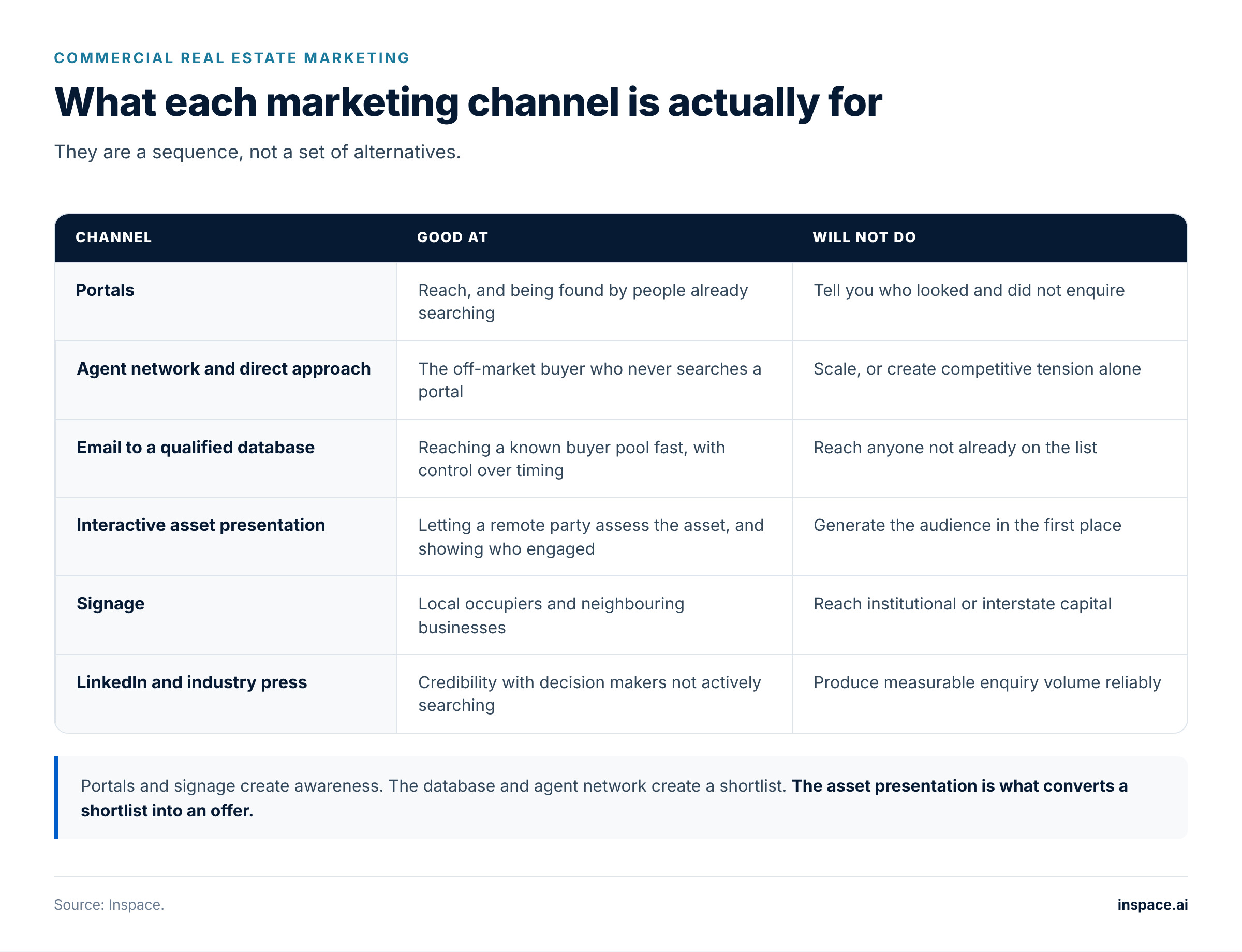
The mistake is treating these as alternatives. They are a sequence. Portals and signage create awareness, the database and agent network create a shortlist, and the asset presentation is what converts a shortlist into an offer.
Measuring a campaign before the deal closes
Commercial transactions take months, so waiting for the result to judge the campaign means finding out too late to change anything. Three measures are available earlier.
Reach, meaning how many relevant parties saw it. Portal views are the crude version. More useful is how many of the parties you specifically wanted to reach actually opened the material.
Depth of engagement. Someone who spends fifteen minutes in an asset presentation is a different prospect from someone who opened a PDF and closed it. Depth is a far better predictor of an offer than raw enquiry count.
Identified interest. This is the one most campaigns cannot measure at all, and it is covered in our guide to property lead generation. Most of the interest in a commercial asset never fills in a form. Knowing which organisations have engaged, rather than only which individuals enquired, changes who you follow up and when.
Five ways commercial campaigns lose deals
The documents disagree with each other. The brochure area, the lease schedule and the information memorandum quote three different figures, or the same figure on three different measurement bases. The buyer does not assume an innocent error, they assume nothing in the pack has been checked.
The asset cannot be assessed from another city. The campaign depends on a physical inspection that a large part of the buyer pool will never make. Those parties do not tell you they dropped the asset, so the loss is invisible and the campaign looks like it simply did not attract interest.
The material leads with the building. Four pages of architecture before the tenancy schedule appears. Every page the buyer reads before reaching the numbers is a page they are skimming, and skimming is how inconsistencies get noticed and context gets missed.
The pack is scattered. Eleven attachments across four emails, two of them superseded, none of them searchable. Every additional place a buyer has to look is a chance for them to look at a competing asset instead.
Nobody knows who engaged. The campaign reports enquiries, which is the small and self-selected part of the audience. The organisations that read the material closely and never filled in a form are the ones worth a phone call, and most campaigns cannot name them.
None of these are failures of effort or spend. Each one is a decision made in the first fortnight that the campaign then has to carry for the next three months.
The campaign checklist
Before a commercial asset goes to market:
1. Every number matches across every document. Area, rent, outgoings, term, dates.
2. The area is stated on a named basis, not just as a figure.
3. A remote decision maker can assess the asset without contacting you.
4. The income evidence is ready, not promised on request.
5. The obvious due diligence questions are already answered in the material.
6. Everything lives in one place with one link.
7. You can tell who engaged, not just who enquired.
8. The opening message leads with the deal, not the building.
One asset, one link, and you can see who looked
The practical problem in commercial marketing is rarely a shortage of effort. It is that the effort produces a scattered pack, sent to people whose level of interest you cannot see, about an asset most of them will never visit.
Inspace puts the whole asset into a single interactive model: floor plates, tenancy areas, availability and asset data in one place, with virtual tours of the real space and of space that has not been built yet. It has been used across more than $190 billion of real estate, identifies anonymous viewers with 90% accuracy, and helps close deals up to 31% faster.
Request a Demo to see how your asset would present.
Frequently asked questions
What is commercial real estate marketing?
Commercial real estate marketing is the work of presenting a commercial asset so that a qualified buyer or tenant can assess it and act. Unlike residential marketing it is aimed at a party making a financial decision against a mandate, often from another city, so it leads with income, lease terms and measured areas rather than presentation and lifestyle. The core assets are consistent headline numbers, a way to understand the space remotely, an information memorandum, evidence that the income is real, and a single place where all of it lives.
How is commercial property marketing different from residential?
The buyer is different, so everything downstream changes. A residential buyer decides emotionally and usually attends in person. A commercial buyer or tenant is underwriting an income stream or an operating cost, frequently decides as a committee, and may never visit the property. That means lease terms, covenant strength, outgoings and measured areas carry the campaign, and any inconsistency between documents does real damage because it forces the buyer to re-verify everything.
What are the best real estate marketing ideas for commercial property?
Lead with the income rather than the architecture. Make the asset assessable remotely, because a large share of tenants expect a virtual tour before they inspect. Answer the obvious due diligence questions inside the material instead of waiting to be asked. Keep every number consistent across the listing, brochure, information memorandum and lease. Put everything behind one link. Measure depth of engagement rather than enquiry count.
How much should a commercial property marketing campaign cost?
It is negotiated, and it varies with the asset value, the method of sale and whether the agent charges marketing separately from commission. Rather than looking for a standard percentage, get two or three written proposals and compare the total cost including marketing, then judge each on whether it produces the five assets that actually do the work. A cheap campaign that cannot be assessed remotely is expensive if it loses an interstate buyer.
How do I know if a commercial campaign is working before the deal closes?
Three signals are available early. Reach, meaning whether the parties you wanted to reach actually opened the material. Depth of engagement, because time spent assessing an asset predicts offers far better than enquiry count does. And identified interest, meaning which organisations have engaged rather than only which individuals filled in a form. Most of the interest in a commercial asset never identifies itself, so campaigns that measure only enquiries are reading a small fraction of the real signal.
Does marketing matter when office vacancy is this high?
It matters more. With national office vacancy at 16.1% in July 2026, the highest since the pandemic, tenants have choice and your asset is being compared against more alternatives than it was five years ago. Marketing will not change the vacancy rate, but it decides whether your floor is on the shortlist that gets inspected or the one that gets filtered out remotely. In industrial, where vacancy is around 3.2%, the job is closer to being first to market than to winning a comparison.

