
Heads of Agreement in Commercial Leases: What to Settle Before You Sign
August 18, 2026
A heads of agreement is a short document, usually one to four pages, that records the commercial terms a landlord and tenant have agreed before a formal lease is drafted. It sets the rent, the term, the incentive, the outgoings and the make good obligation. It is normally intended not to be legally binding, and it is normally the most consequential document in the whole deal.
Those last two facts sit awkwardly together, which is why heads of agreement cause so much trouble.
The reason it matters is not really legal. It is commercial. Almost everything in a lease that costs money is decided at the heads of agreement stage, by people who are not lawyers, in a document nobody treats as important. By the time solicitors are drafting the lease, the commercial terms are settled and reopening them reads as bad faith. The window to negotiate closes when the heads of agreement is signed, and most tenants do not notice it closing.
This guide covers what belongs in one, what happens if you get the binding question wrong, and the terms that become almost impossible to move afterwards.
A note on what this is. This article explains commercial practice, not law, and it is not legal advice. Whether any particular document binds you turns on its exact wording and on what the parties did, which is a question for a lawyer looking at your document. Get one before you sign.
The negotiation window, and why it closes early
Think about the sequence of a typical leasing deal. An agent shows you space. You negotiate rent, term and incentive, mostly by email and phone. Someone sends a one-page summary of what has been agreed. You sign it, because it says it is not binding and because signing feels like progress. The landlord's solicitor drafts the lease from that document. Your solicitor reviews it, negotiates the legal machinery, and you execute.
Notice where the money was decided. Not in the lease negotiation. In the email exchange and the summary, before anyone with legal training was involved.
That is the structural problem. A lease negotiation is about risk allocation: indemnities, default provisions, assignment mechanics, insurance. All of it matters, and none of it changes the rent. The commercial terms were locked in earlier, and a landlord who has already agreed a deal has no reason to improve it because your solicitor has now read it properly.
So this is the document where your bargaining power gets spent. Not the lease.

What goes in a heads of agreement
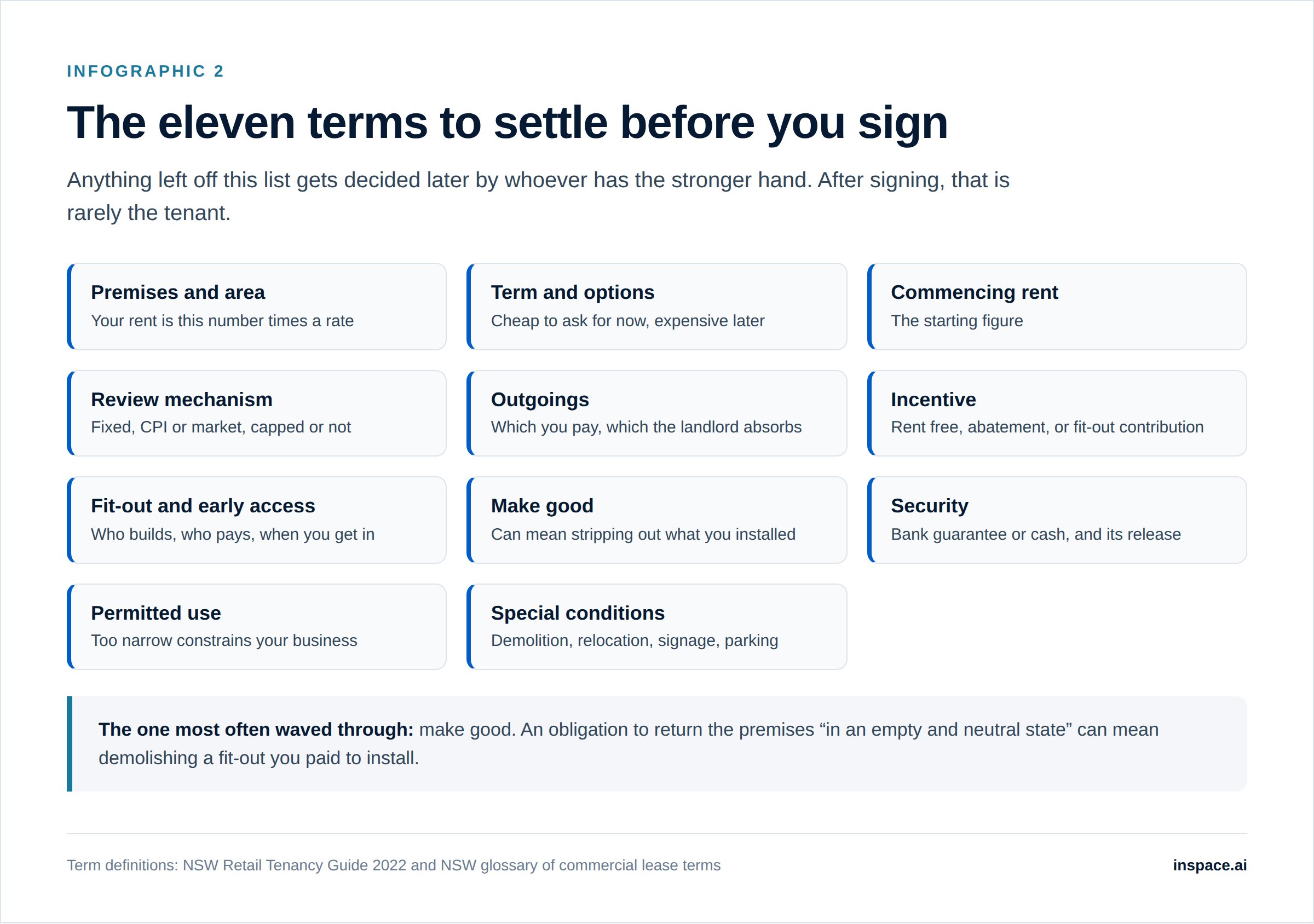
At minimum, the document should settle the following. Anything left out is decided later by whoever has the stronger hand, and after signing that is rarely the tenant.
The premises and the area. Which suite, which floor, and how many square metres. The area figure is not a formality, because your rent is that number multiplied by a rate. If the area is overstated you pay for space you do not have, for the whole term. Our guide to net lettable area covers how the figure is measured and where it goes wrong.
The term, and the options. How long, from when, and what renewal rights you have. An option is, in the NSW Government's words, "a right for the tenant to call for a new lease with the same terms as their current lease, for a new fixed period of years". Options are cheap to ask for at this stage and expensive later.
The commencing rent, and the review mechanism. The starting figure matters less than how it moves. Fixed percentage, CPI, market review, or a combination, and whether market reviews are capped or ratcheted.
Outgoings. Which ones you pay and which the landlord absorbs. The NSW Government defines outgoings as costs the lessor incurs operating and maintaining the premises "which are typically passed on to the lessee". The word "typically" is doing a lot of work there, and the split is negotiable.
The incentive. In the current market this is a large number and it takes several forms: a rent-free period, a rent abatement across part or all of the term, or a landlord contribution to your fit-out. Specify which, how much, when it is paid, and what happens to it if you default or assign.
Fit-out, and early access. Who builds what, who pays, and when you can get in to start. If you need six weeks of fit-out before trading, that is a commercial term, not a detail.
Make good. What condition you must return the premises in. These provisions typically require the tenant to return the premises "in an empty and neutral state", which can mean stripping out a fit-out you paid to install. Agreed casually now, it can cost six figures at the end of the term.
Security. A bank guarantee or a cash deposit. Note the amount, usually expressed in months of gross rent, and the circumstances for its release.
Permitted use. Drawn too narrowly, it constrains how your business can change. Drawn too broadly, the landlord will resist.
The special conditions. Anything deal-specific: a demolition or relocation clause, exclusivity in a centre, signage rights, after-hours air conditioning, loading dock access, car parking.
Fit-out consultants make a point worth repeating. Services capacity, access hours and landlord works are exactly what fit-out depends on, and "if you do not raise these at HoA stage, the landlord has no commercial reason to vary them once the lease is drafted."
Is a heads of agreement binding?
The honest answer is that it depends on what the document says and on what the parties then did, and that Australian courts have been working through this question since 1954.
The framework comes from Masters v Cameron [1954] HCA 72, which remains the leading Australian authority. Dixon CJ, McTiernan and Kitto JJ described three classes of case where parties reach agreement but also contemplate a formal contract:
"It may be one in which the parties have reached finality in arranging all the terms of their bargain and intend to be immediately bound to the performance of those terms, but at the same time, propose to have the terms restated in a form which will be fuller or more precise but not different in effect. Or, secondly, it may be a case in which the parties have completely agreed upon all the terms of their bargain and intend no departure from or addition to that which their agreed terms express or imply, but nevertheless have made performance of one or more of the terms conditional upon the execution of a formal document. Or, thirdly, the case may be one in which the intention of the parties is not to make a concluded bargain at all, unless and until they execute a formal contract."
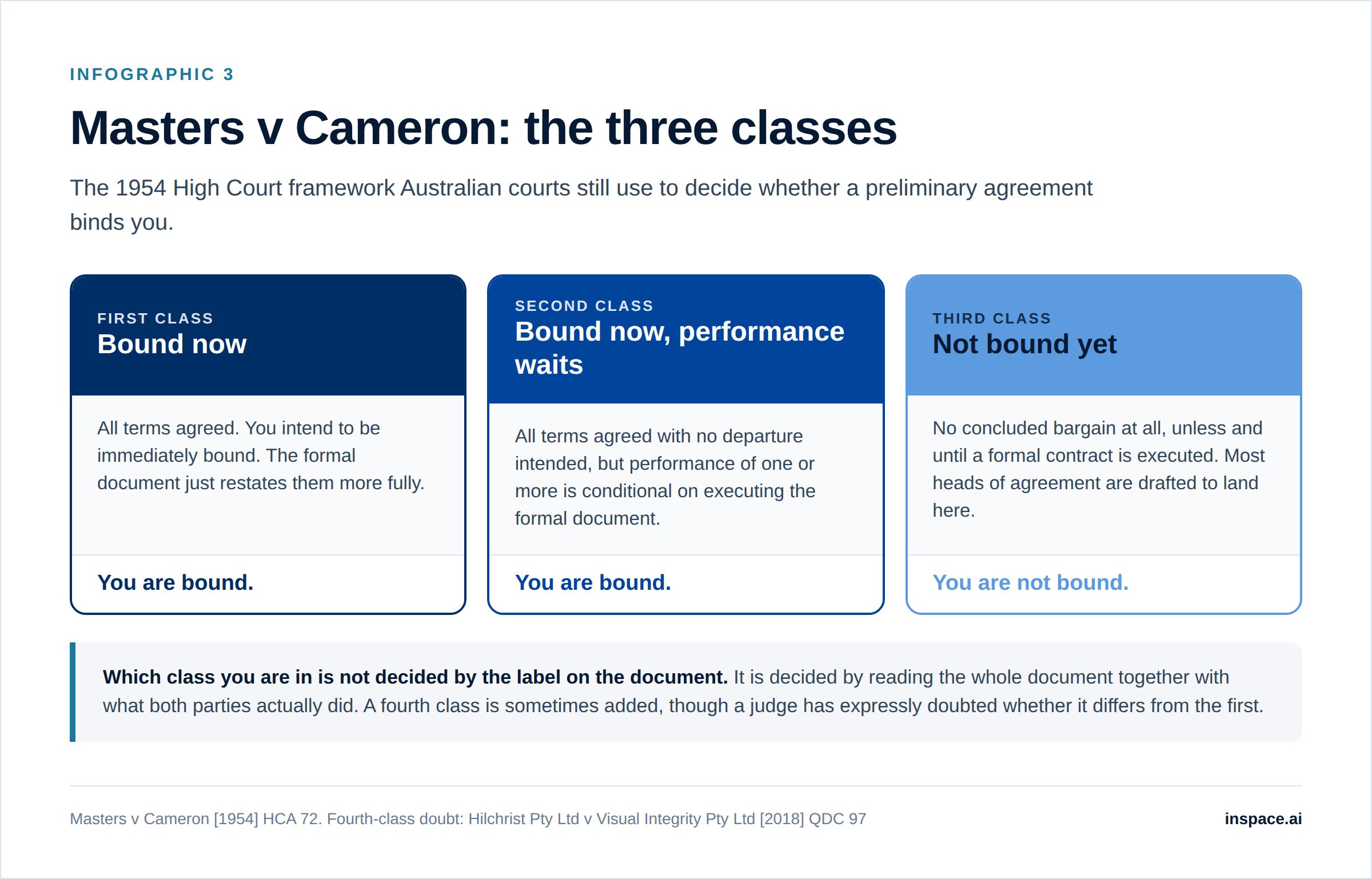
In plain terms. First class: you are bound now, and the formal document just tidies it up. Second class: you are bound now, but performance waits for the formal document. Third class: you are not bound at all until it is signed.
Most of these documents are drafted to land in the third class. Whether they actually do is decided by reading the whole document and the parties' conduct, not the label on the front page.
A fourth class is sometimes added, where the parties are bound immediately by what they have agreed while expecting a fuller contract to replace it. Worth knowing that this is less settled than most commentary suggests: in Hilchrist Pty Ltd v Visual Integrity Pty Ltd [2018] QDC 97 the judge noted the suggested fourth category but said he had "difficulty in distinguishing it from the first category".
Two cases that show both extremes
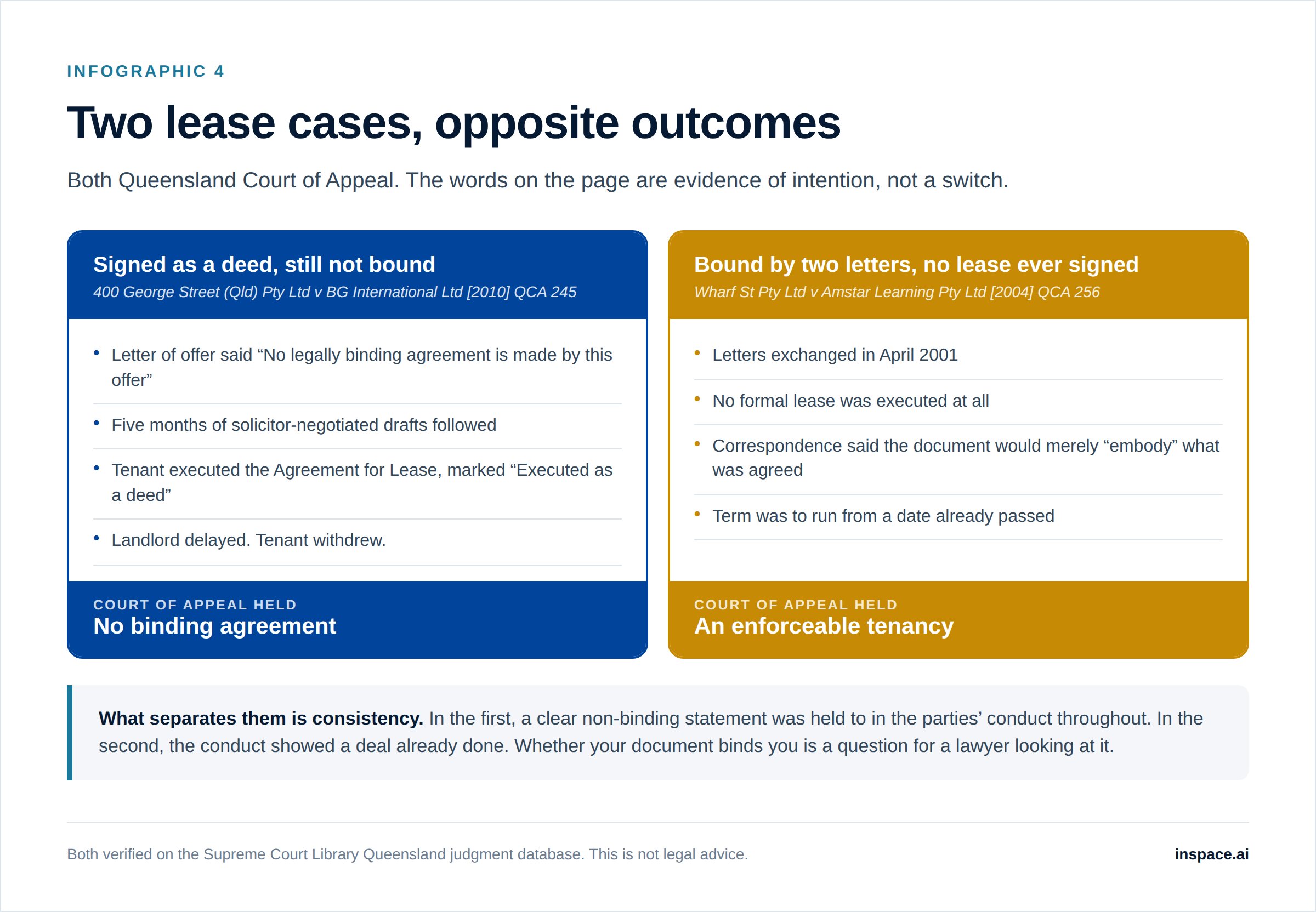
The gap between what a document says and what a court decides shows up in two Queensland Court of Appeal decisions that went opposite ways, both about leases.
A tenant signed the formal agreement as a deed and was still not bound. In 400 George Street (Qld) Pty Ltd v BG International Ltd [2010] QCA 245, the landlord's letter of offer said plainly: "No legally binding agreement is made by this offer. All documentation is subject to a mutually agreed legal document by both parties." Five months of solicitor-negotiated drafts followed. The tenant then executed the Agreement for Lease, marked "Executed as a deed" and "Signed, sealed and delivered", and returned it. The landlord delayed. The tenant withdrew.
The Court of Appeal held there was no binding agreement. Despite the deed language, the instrument "was not delivered as a binding deed", because the original letter and the parties' conduct established that no legal obligations would arise until all parties were bound. A clear non-binding statement, held to consistently, survived even the tenant's own execution.
A landlord and tenant were bound by two letters, with no lease ever signed. In Wharf St Pty Ltd v Amstar Learning Pty Ltd [2004] QCA 256, letters exchanged in April 2001 created an enforceable tenancy. No formal lease was executed at all. The correspondence indicated the formal document would merely "embody" what was already agreed, and the term was to run from a date that had already passed. First class.
The lesson is not that these documents are dangerous. It is that the words on the page are evidence of intention, not a switch. Consistency between document and conduct decides it.
"Subject to lease" is not a magic spell
Both sides tend to treat "subject to lease" or "subject to contract" as a safety net making everything above it provisional. It is better than nothing. It is not a guarantee.
In Stellard Pty Ltd v North Queensland Fuel Pty Ltd [2015] QSC 119, an offer sent by email was marked "subject to contract" and the acceptance was expressed as "subject to execution of the Contract". The Supreme Court of Queensland held a binding contract had been formed anyway, in the first Masters v Cameron class, because every essential term had been agreed. That case concerned a sale of land rather than a lease, but the formation principle is the same one that applies to an agreement for lease.
If everything material is settled and both sides behave as though the deal is done, a qualifying phrase may not save you. Which cuts both ways: a landlord who assumes they are still free to market the premises can be as surprised as a tenant who assumes they can walk away.
What actually creates the lease is possession and rent, not signatures
This is the part almost nobody knows, and for retail premises it is written directly into the statute.
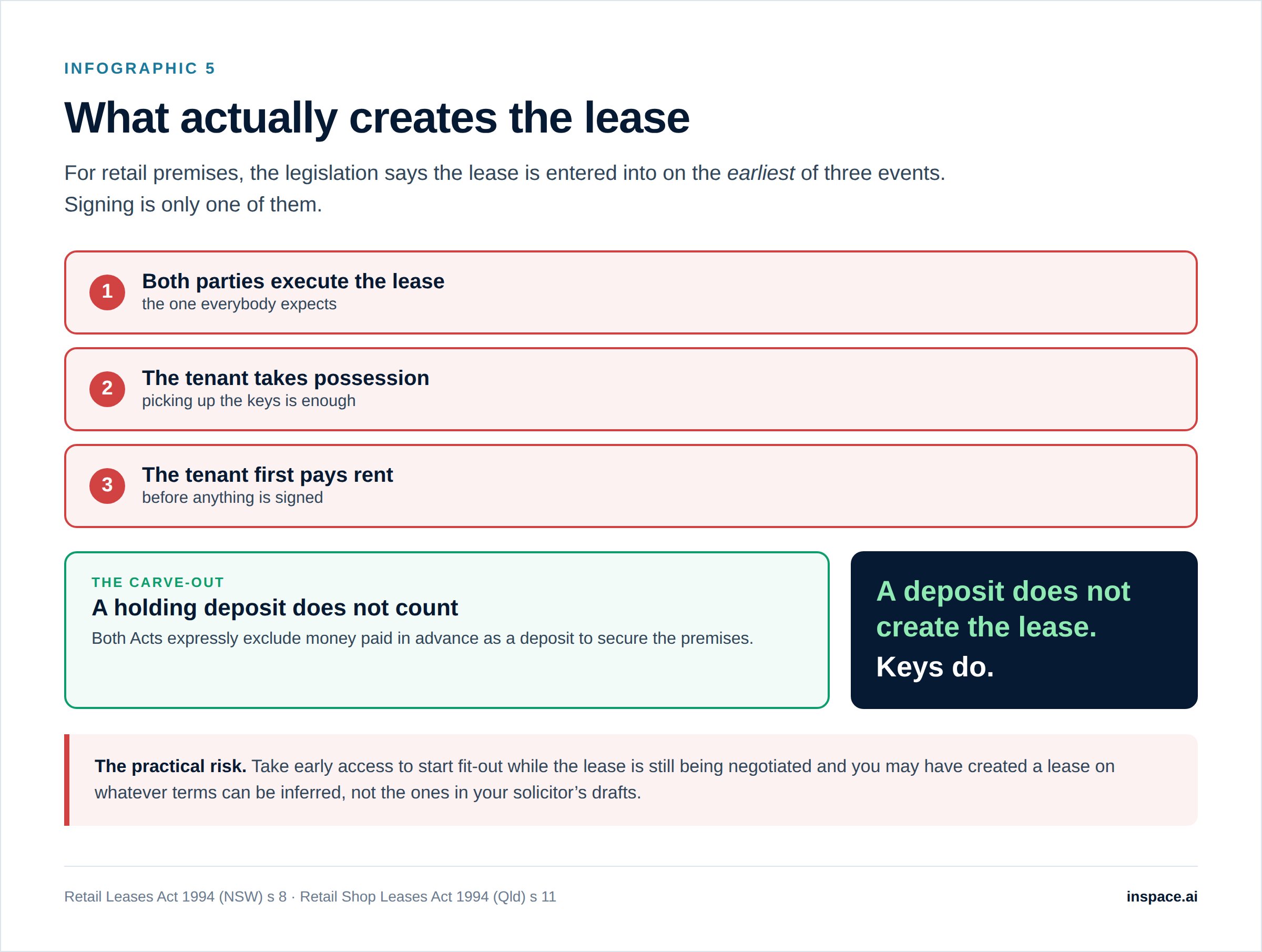
Under section 8 of the Retail Leases Act 1994 (NSW), a retail shop lease is entered into on the earliest of three events: both parties executing it, the tenant entering into possession as lessee, or the tenant beginning to pay rent as lessee. Queensland's Retail Shop Leases Act 1994 does the same thing in section 11.
Read that again, because the order matters. Taking the keys creates the lease. Not signing.
The NSW Government's own retail tenancy guidance says it without qualification: a lease can start even if an agreement has not been signed, if the lessee takes possession of the premises, or the lessee begins to pay rent.
And there is a carve-out worth knowing, because it is the one piece of good news in this section. Both Acts expressly exclude a holding deposit. In NSW, money paid in advance as a deposit to secure premises does not count as rent. Queensland's provision excludes rent paid "as a deposit to secure the premises for the lease".
So a holding deposit does not create the lease. Keys do.
The practical consequence: if you take early access to start fit-out while the lease is still being negotiated, you may have created a lease on whatever terms can be inferred, rather than the carefully negotiated terms still sitting in your solicitor's drafts. If you need early access, and tenants frequently do, get the basis of that access documented before you walk in.
The clauses you want binding, even when the rest is not
A document that is entirely non-binding protects you from being locked in and gives you nothing while the lease is drafted. Which is why market practice is to carve out a few provisions that bind immediately.
The two usual ones are confidentiality, and exclusivity, which stops the landlord marketing the premises to anyone else for a fixed window, commonly 30 to 60 days. Deposits, cost undertakings and an agreed deadline for executing the lease are also often carved out.
If you want those to work, say so explicitly. A document that states which clauses bind and which do not is far easier to rely on than one leaving a court to infer it. Worth noting that in 400 George Street it was the tenant who inserted an exclusivity clause into an expressly non-binding letter of offer, which is this practice in action.
No Australian case appears to have decided whether such a carve-out is enforceable in a document of this kind, so treat it as standard practice rather than settled law, and have your solicitor draft the wording.
The disclosure gap
Here is a timing problem that catches retail tenants specifically, and it follows directly from signing early.
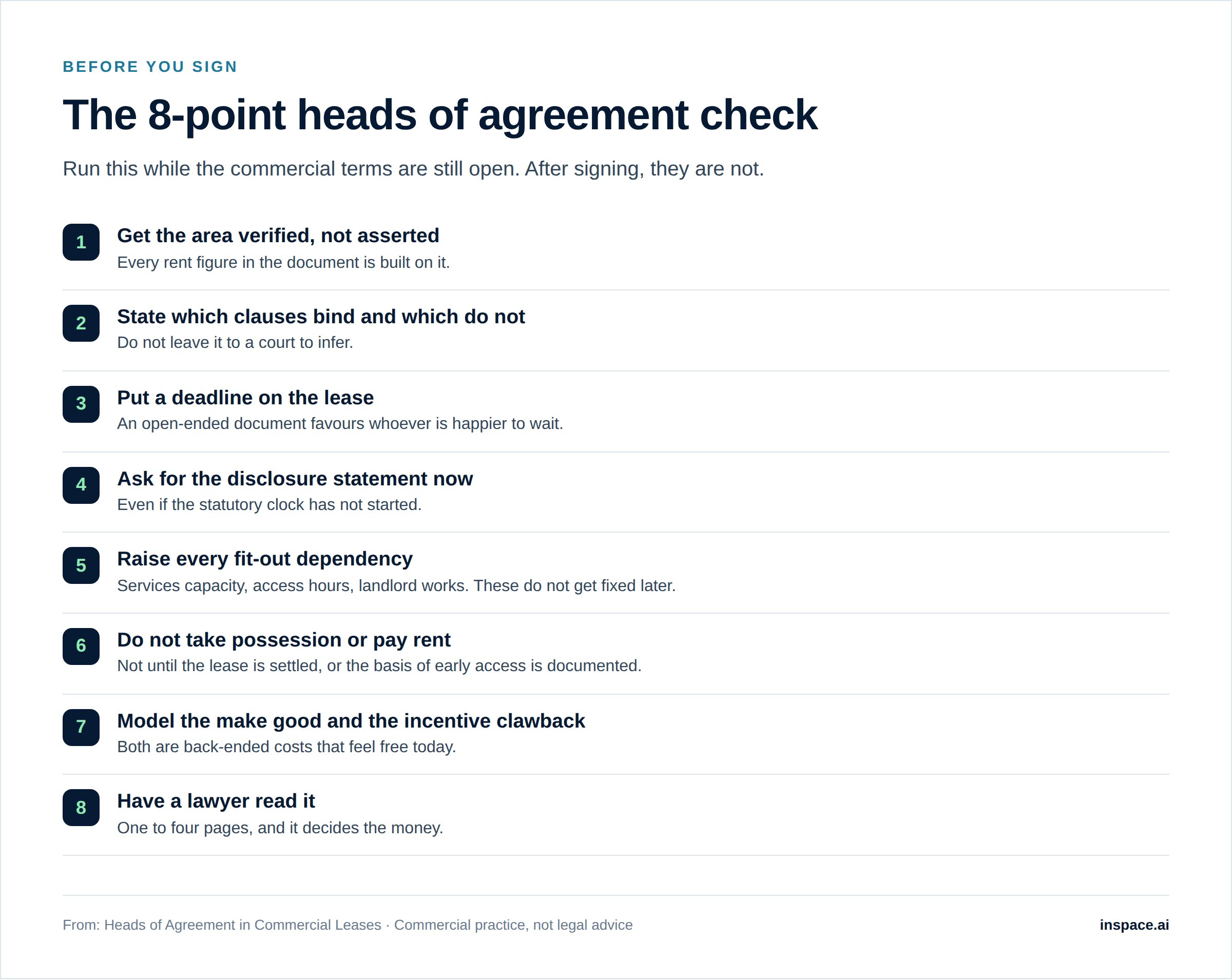
In states with retail leases legislation, a landlord must give the tenant a disclosure statement before the lease is entered into: at least 7 days before in New South Wales, at least 14 days before in Victoria, together with a copy of the proposed lease.
But the clock runs from when the lease is entered into. So the sequence you will often experience is: negotiate, sign, and only then receive the disclosure you were entitled to. At this stage no disclosure statement has usually been prepared at all.
That matters because the disclosure statement is where the numbers you have just agreed get itemised. Victoria's prescribed content includes the term, any options, the occupancy costs including rent and outgoings, fit-out requirements, and whether there are relocation or demolition clauses. If any of it differs from what you signed, you would rather know beforehand.
The remedies are real but awkward. In NSW, if the disclosure statement is not given, is incomplete, or is materially false or misleading, the tenant may terminate by written notice within 6 months after the lease was entered into, and may recover costs reasonably incurred in entering the lease, expressly including compensation for fit-out expenditure. In Victoria, late disclosure pushes the lease commencement out: the term "is taken to commence 14 days after the disclosure statement and proposed lease are given". A tenant may also withhold rent until disclosure occurs, and has 28 days to terminate if the statement is misleading, false or materially incomplete.
One Victorian wrinkle worth raising with your lawyer. The Retail Leases Act 2003 defines "lease" to include "an agreement for a lease or sub-lease, whether or not in writing". If the document is binding and amounts to an agreement for lease, there is an argument the 14 day clock should have been measured from before it was signed. No case or regulator statement confirming that reading could be found, so it is an argument rather than a settled position, but it is the right question to ask.
A final observation. Search the NSW Retail Tenancy Guide, the pre-lease factsheets, the Victorian Small Business Commission's leasing pages and the Queensland retail lease forms, and the phrase "heads of agreement" does not appear anywhere. The document the market signs first is not acknowledged in the statutory guidance at all. Which tells you how much protection to expect from it.
Before you sign
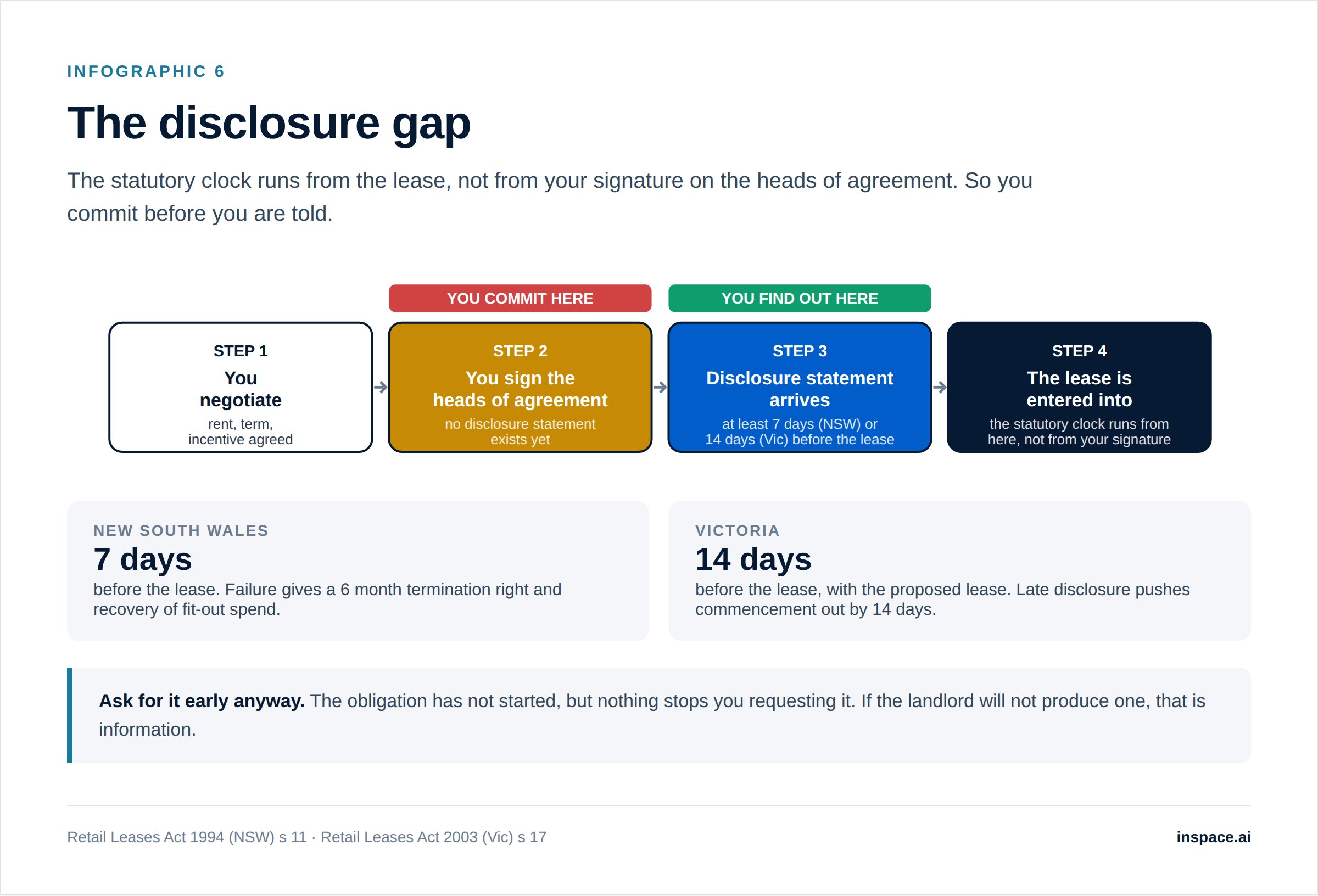
- Get the area verified, not asserted. Every rent figure in the document is built on it.
- State plainly which clauses bind and which do not. Do not leave it to inference.
- Put a deadline on the lease. An open-ended non-binding document favours whoever is happier to wait.
- Ask for the disclosure statement now, even if the statutory clock has not started. If the landlord will not produce it, that is information.
- Raise every fit-out dependency, including services capacity, access hours and landlord works. These do not get fixed later.
- Do not take possession or pay rent until the lease is settled, unless you have documented the basis of early access.
- Model the make good and the incentive clawback before you agree either. Both are back-ended costs that feel free today.
- Have a lawyer read it before you sign it. It is one to four pages. This is a cheap review, and it is the document that decides the money.
Presenting the deal so the terms are the argument
Most of the friction in the pre-lease phase comes from scattered information. The area is in one email, the availability in a brochure, the floor plan in a PDF, the condition of the premises visible only on a site visit the tenant may not have made.
That is a slower deal for the landlord and a worse-informed decision for the tenant. When a tenant can see the actual floor plate, the tenancy areas and the real condition of the space in one place before terms are drafted, fewer deals get renegotiated and fewer die between the summary and the lease.
Inspace puts availability, floor plates, tenancy areas and virtual tours of the real space into one interactive model of the building, and Inspace for Leasing turns the leasing pack into a trackable presentation, so you can see exactly which floors a prospective tenant looked at and for how long. Landlords using Inspace report closing deals up to 31 per cent faster, and around 60 per cent of tenants now expect to see a tour before they inspect in person.
Request a demo to see how your building would present.
Frequently asked questions
What is a heads of agreement in a commercial lease?A heads of agreement is a short document, usually one to four pages, recording the commercial terms a landlord and tenant have agreed before a formal lease is drafted. It typically covers the premises, area, term, options, commencing rent, review mechanism, outgoings, incentive, fit-out, make good, security and permitted use.
Is a heads of agreement legally binding in Australia?It depends on the wording and on what the parties did. Australian courts apply the framework from Masters v Cameron, which distinguishes between agreements where the parties intended to be bound immediately and those where nothing binds until a formal document is executed. Most heads of agreement are drafted to be non-binding, but conduct can override the drafting, so get legal advice on your specific document.
Does "subject to lease" make a heads of agreement non-binding?Not automatically. It is evidence of intention rather than a guarantee. In Stellard Pty Ltd v North Queensland Fuel Pty Ltd [2015] QSC 119 a court found a binding contract had formed despite the offer being marked "subject to contract", because all essential terms had been agreed.
What is the difference between a heads of agreement and a lease?A heads of agreement records the commercial terms and is usually intended not to bind. A lease is the enforceable document granting the right of occupation, and it contains both the commercial terms and the legal machinery: default provisions, indemnities, insurance, assignment and repair obligations. The heads of agreement is the input; the lease is the instrument.
Can I get out of a heads of agreement?Often yes, if it was genuinely non-binding and neither party has acted as though the deal was concluded. But that is a question about your particular document and the conduct of both sides, and for retail premises taking possession or paying rent may have created a lease regardless. This is a question for a lawyer, not a general answer.
When does a commercial lease actually start?For retail premises in NSW and Queensland, the legislation says the lease is entered into on the earliest of execution by both parties, the tenant taking possession, or the tenant first paying rent. Both Acts exclude a holding deposit paid to secure the premises. So taking the keys can create the lease before anything is signed.
Should the landlord give me a disclosure statement before the heads of agreement?The statutory obligation is tied to the lease, not the heads of agreement, so usually you will receive it afterwards: at least 7 days before the lease in NSW, and at least 14 days before in Victoria. You can ask for it earlier anyway, and it is worth doing, because it itemises the terms you are about to commit to.
Which parts of a heads of agreement are usually binding?Market practice is to carve out confidentiality and exclusivity, which stops the landlord marketing the premises to others for a set window, commonly 30 to 60 days. Deposits, cost undertakings and a deadline for executing the lease are also often carved out. Say explicitly which clauses bind, rather than leaving a court to infer it.
Do I need a lawyer for a heads of agreement?It is one to four pages and it decides the commercial terms of a multi-year commitment, so a review is inexpensive relative to what it protects. The commercial terms are far harder to change once the lease is being drafted, which makes advice at this stage more valuable than advice later.

%201.svg)