

Real Estate Lead Generation: How to Capture and Identify Property Enquiries
September 27, 2026
Most of the interest in a commercial property never identifies itself.
A buyer's analyst downloads the information memorandum from a forwarded link. A tenant representative reads the listing four times across a fortnight. An institution's acquisitions team opens the floor plan, measures it against a brief and decides the floor plate is wrong. None of those people fill in a form, and none of them appear in the enquiry report. The campaign is judged on the small, self-selected fraction of the audience that chose to raise a hand.
Real estate lead generation is the work of fixing that in two directions at once: creating enquiry, and seeing the interest that never becomes an enquiry.
This guide covers where commercial property leads actually come from, what to capture when one arrives, how to qualify it without annoying the lead, and what to do about the much larger group that stays anonymous.
What counts as a lead in commercial property
A commercial property lead is a party who has shown interest in a specific asset or in a specific requirement, and who can be identified well enough to contact.
That definition does two useful things. It excludes anonymous traffic, which is interest without identity, and it excludes a name on a database, which is identity without interest. Both are valuable, but neither is a lead, and counting them as leads is how a campaign ends up reporting four hundred leads and two offers
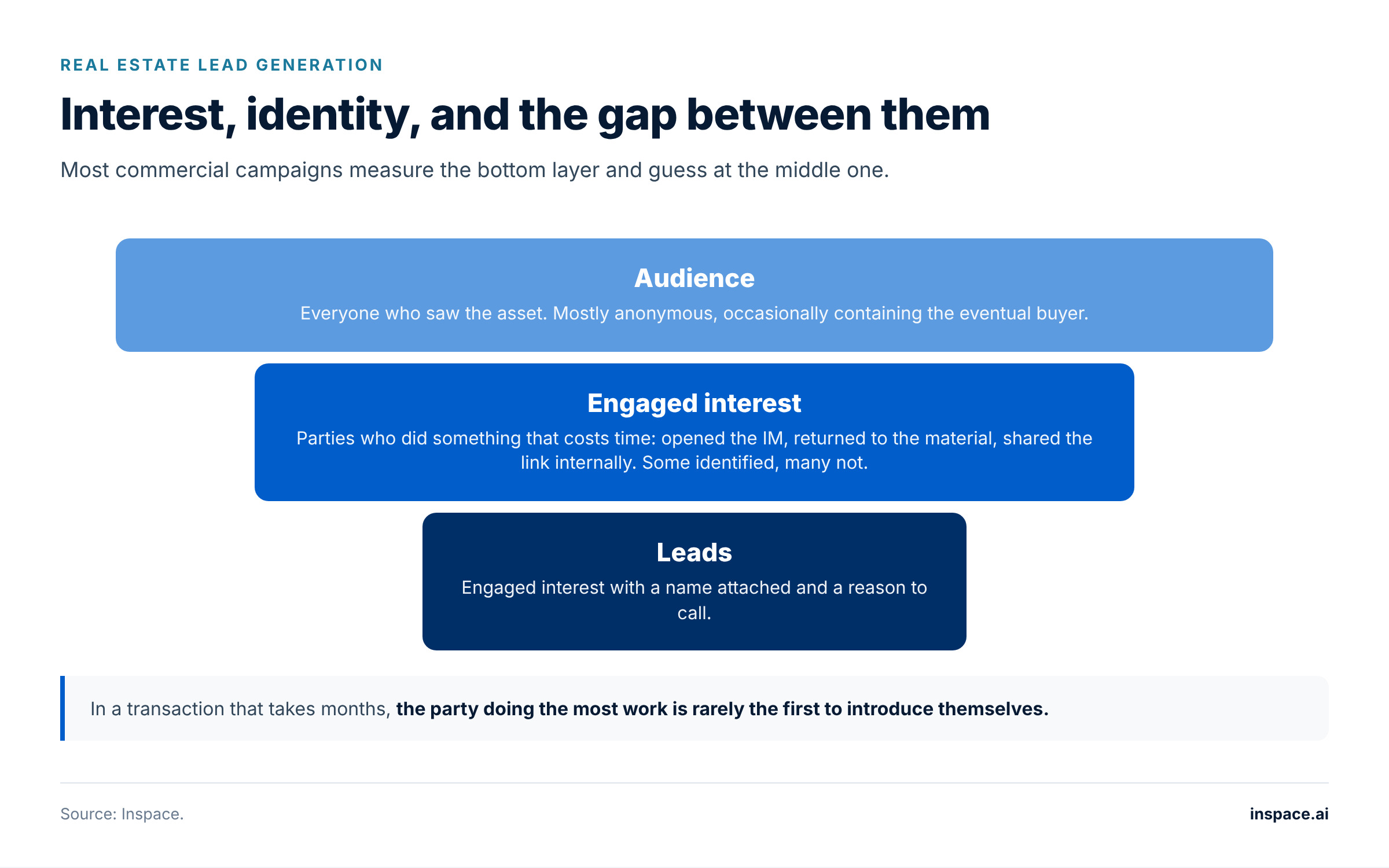
The useful mental model has three layers:
- Audience. Everyone who saw the asset. Mostly anonymous, mostly irrelevant, occasionally containing the eventual buyer.
- Engaged interest. Parties who did something that costs time: opened the IM, returned to the material, walked the model, shared the link internally. Some identified, many not.
- Leads. Engaged interest with a name attached and a reason to call.
Most commercial campaigns measure the third layer and guess at the second. The second layer is where the deal usually is, because in a transaction that takes months, the party doing the most work is rarely the first to introduce themselves.
Where commercial property leads actually come from
The last row is the one most teams have no system for. A party who ran numbers on an asset eighteen months ago and did not buy it is better qualified than almost anyone on a portal, and in most agencies that information lives in one person's memory.
The identification problem, and what can be done about it
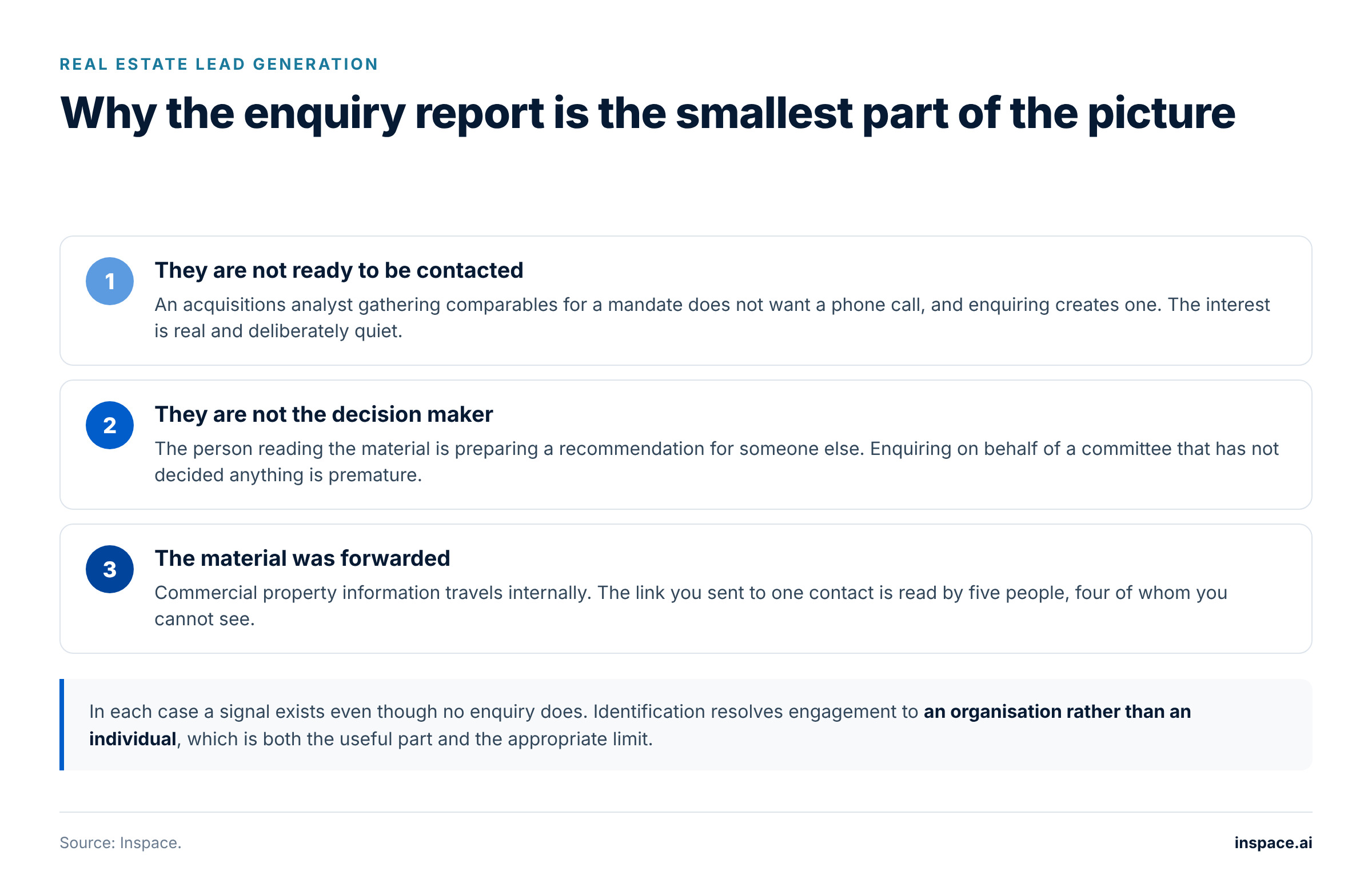
There are three reasons a genuinely interested party stays anonymous.
They are not ready to be contacted. An acquisitions analyst gathering comparables for a mandate does not want a phone call, and enquiring creates one. Interest at this stage is real but deliberately quiet.
They are not the decision maker. The person reading the material is preparing a recommendation for someone else. Enquiring on behalf of a committee that has not decided anything is premature, so they do not.
The material was forwarded. Commercial property information travels internally. The link you sent to one contact is read by five people, four of whom you have never heard of and cannot see.
In each case there is a signal available even though there is no enquiry. The organisation visited, the material was opened, time was spent, the link was shared. Visitor identification works on the network and firmographic layer rather than the personal one: it tells you which company engaged, not which individual, which is both the useful part and the appropriate limit.
That changes the follow-up from a cold call to a warm one. Calling a contact at a firm whose team has spent twenty minutes in your asset presentation is a different conversation from calling a list.
What to capture when an enquiry does arrive
Enquiry forms are usually built to minimise friction, which is correct for the first contact and wrong for the second. The fix is to take almost nothing up front and build the picture afterwards.
On the form: name, organisation, email, phone. That is the whole list. Every additional field reduces completion, and anything else you need can be established in the first conversation or inferred from the organisation.
In the first reply, within hours. Commercial enquiries are not urgent in the residential sense, but they are comparative. A party enquiring on your asset is enquiring on three others the same week, and the first substantive reply frames the comparison.
In the record, after the call.
The point of the record is not the current deal. It is that a commercial agency's most valuable asset is an accurate picture of who wants what, and that picture is built one enquiry at a time or not at all.
Qualifying without interrogating
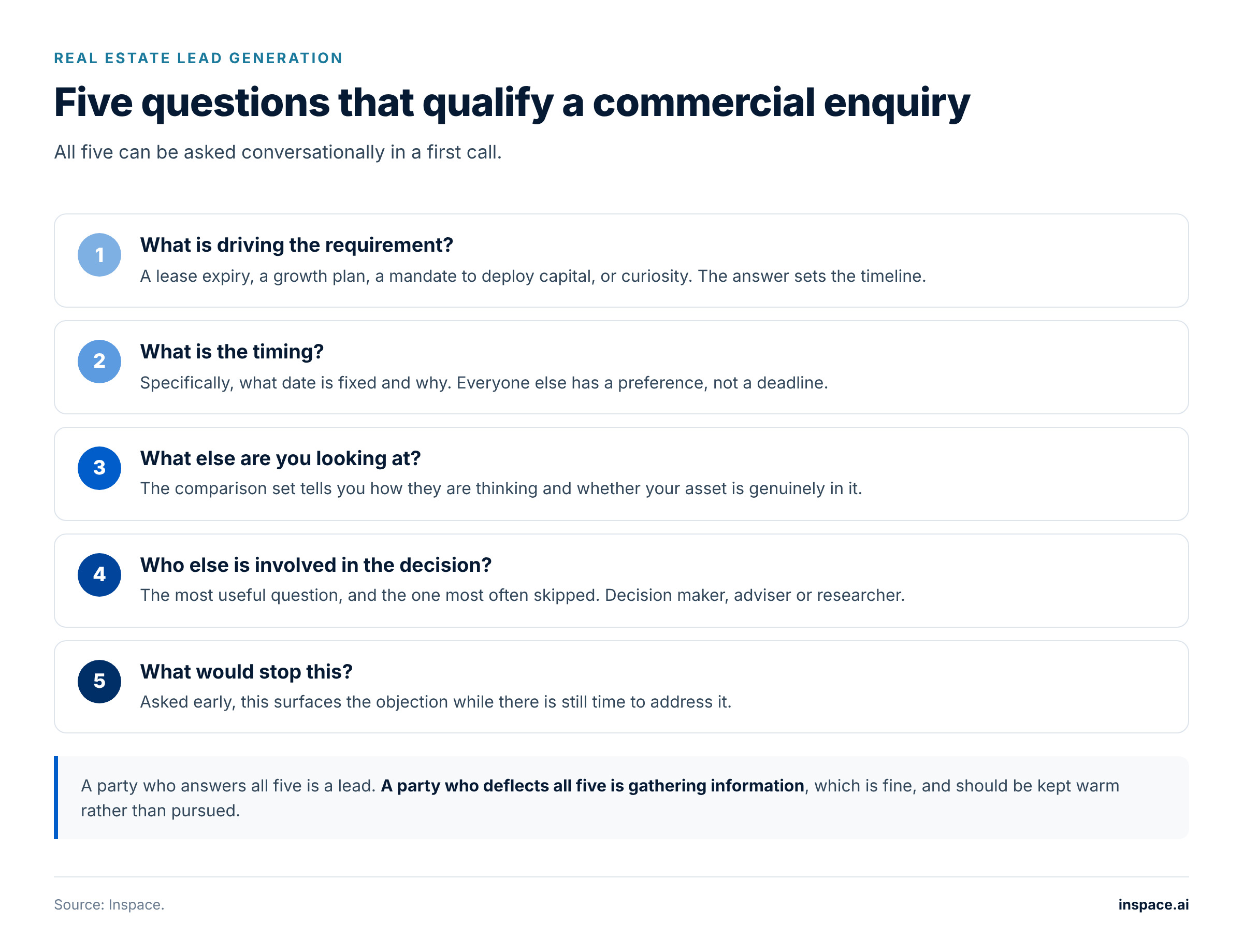
Five questions do most of the work, and all five can be asked conversationally in a first call.
1. What is driving the requirement? A lease expiry, a growth plan, a mandate to deploy capital, or curiosity. The answer sets the timeline.
2. What is the timing? Specifically, what date is fixed and why. A tenant with a lease expiring in March has a deadline. An investor with capital to deploy by June has a deadline. Everyone else has a preference.
3. What else are you looking at? Not to be competitive about it, but because the comparison set tells you how they are thinking and whether your asset is genuinely in it.
4. Who else is involved in the decision? The single most useful question, and the one most often skipped. It establishes whether you are speaking to the decision maker, an adviser or a researcher.
5. What would stop this? Asked early, this surfaces the objection while there is still time to address it, rather than at the point of offer.
A party who answers all five is a lead. A party who deflects all five is gathering information, which is fine, and should be kept warm rather than pursued.
The follow-up sequence, because one call is not a process
Commercial decisions take months, and a single follow-up call three days after the enquiry is the point at which most leads quietly die. The party was researching, the timing was wrong, and nobody called again.
A workable sequence has four touches and spans the length of the decision, not the length of the campaign.
Touch one, same day. A substantive reply that answers the obvious questions outright: the area and its measurement basis, the rent or price expectation, the outgoings, the term and the availability date. The goal is that they can progress their analysis without needing anything else from you.
Touch two, within the week. A call with the five qualifying questions. This is also where you find out whether the person who enquired is the person deciding, which changes everything that follows.
Touch three, at the point their timeline says to. Not on a fixed cadence. If their lease expires in March, the call that matters is in October, and a generic monthly check-in before then burns the relationship for no return.
Touch four, when something changes. A price adjustment, a new incentive, a comparable transaction nearby, a tenant leaving a floor they wanted. A reason to call that is about them rather than about your pipeline.
Between those touches, engagement data does the work. A party who returns to the material unprompted has told you something without being asked, and that is the moment to call rather than the day the calendar reminder fires.
Lead generation looks different in a tight market and a loose one
The same activity produces very different results depending on the market the asset sits in, and treating lead generation as a fixed process across a portfolio produces predictable disappointment.
In office, where national vacancy reached 16.1% in July 2026, the limiting factor is demand. There are not many active tenant requirements in the market at any moment, and the ones that exist are being chased by every agent in the city. Generating leads here is mostly about being visible to a small, known pool and being the easiest asset in that pool to assess. Volume tactics produce volume, and almost none of it is real.
In industrial, where vacancy sat near 3.2%, the limiting factor is supply. Requirements outnumber available space, so leads are not the constraint and qualification is. The work shifts to sorting a crowded field quickly, because the cost of spending three weeks on an underqualified party is a better party going elsewhere.
The practical consequence: an office campaign should spend its effort on depth of engagement with a small pool, and an industrial campaign should spend its effort on qualifying a large one fast. Running those two the other way around is one of the more expensive mistakes in the business, and it is usually made by applying one agency process to both.
What to measure
Lead counts are a poor measure of a commercial campaign because the numbers are small and the quality varies enormously. Four measures are more honest.
Qualified enquiries, not enquiries. The count after the five questions, which is usually a fraction of the raw number and a far better predictor of the result.
Identified organisations engaged. How many companies, not individuals, spent real time in the material. This is the number that tells you whether the campaign reached the right market.
Depth per party. Time spent, pages or areas viewed, repeat visits. A party that returns three times is further along than a party that enquired once.
Source attribution that survives the first touch. Most commercial deals have several touches across months. Crediting the deal to the last click tells you nothing useful about where to spend next time.
See the interest that never raises its hand
The gap in most commercial lead generation is not effort. It is that the campaign can see enquiries and cannot see interest, so follow-up goes to the parties who were polite enough to identify themselves rather than the parties doing the most work.
Inspace puts the asset into a single interactive model that a prospect can explore without contacting anyone, and tells you which organisations did. It identifies anonymous viewers with 90% accuracy, is used across more than $190 billion of real estate, and helps teams close deals up to 31% faster. Our guide to commercial real estate marketing covers how that fits into a full campaign.
Request a Demo to see who is looking at your assets.
Frequently asked questions
What is real estate lead generation?
Real estate lead generation is the process of creating and capturing interest from parties who want to buy, lease or invest in property, and converting that interest into contactable, qualified leads. In commercial property it has two halves: generating enquiry through portals, databases, agent networks, signage and content, and identifying the much larger group of interested parties who engage with the material without ever enquiring.
How do you generate commercial property leads?
The reliable sources are portal listings, a maintained database of buyers and tenants with recorded requirements, direct approaches from the agent's own network, website content that answers the questions buyers are already searching for, signage for smaller assets, and referrals from valuers, brokers and other agents. The highest quality source in most agencies is the record of parties who looked at a comparable asset previously and did not transact.
How do I identify anonymous website visitors on a property listing?
Visitor identification works at the organisation level rather than the individual level, using network and firmographic data to resolve a visit to a company. It tells you which firms engaged with an asset, how long they spent and what they looked at, without identifying a named person. That is enough to turn a cold follow-up call into a warm one, and it covers the large share of commercial interest that never fills in a form.
What should a property enquiry form ask for?
Name, organisation, email and phone. Nothing else. Every additional field reduces the number of people who complete it, and the requirement, timing, decision process and funding position are all better established in the first conversation than guessed at through a dropdown.
How quickly should you respond to a commercial property enquiry?
Within hours rather than days. Commercial enquiries are comparative rather than urgent, because a party enquiring on your asset is usually enquiring on several others in the same week. The first substantive reply sets the frame for that comparison, and a reply that answers the obvious questions outright does more than a fast reply that only offers a time to talk.
How do you qualify a commercial real estate lead?
Establish what is driving the requirement, what date is actually fixed, what else they are considering, who else is involved in the decision, and what would stop the deal. A party who engages with all five is a lead worth working. A party who answers none is gathering information, which is worth keeping warm but not worth chasing.

