

Cap Rate Explained: How to Calculate Capitalisation Rate
August 24, 2026
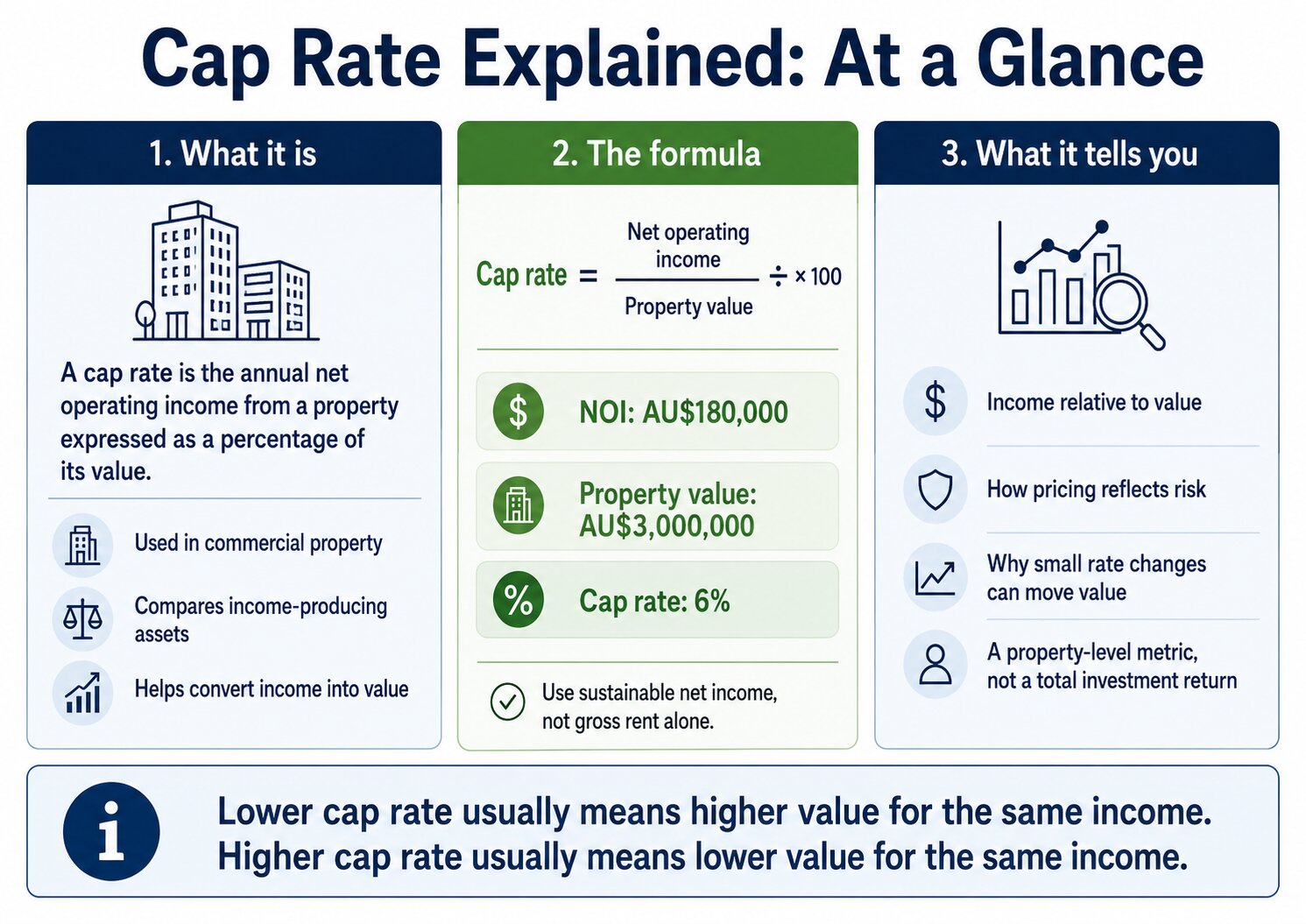
A cap rate, short for capitalisation rate, is the annual net income from a property expressed as a percentage of its value or purchase price.
The formula is:
Cap rate = Net operating income ÷ Property value × 100
If a commercial property produces $180,000 a year in net operating income and is worth $3 million, its cap rate is 6%.
That percentage links income, value and market risk. It helps investors compare income-producing assets, helps valuers convert stabilised income into value, and explains why an asset can change value even when its rent has not changed.
The arithmetic is easy. The harder part is deciding what belongs in net operating income, which market evidence supports the rate, and what the result actually tells you.
This guide explains how cap rates work in Australian commercial property, how to calculate one properly, how cap rate compression and expansion affect value, and why there is no single “good cap rate” for every asset.
What is a cap rate?
A capitalisation rate is the rate used to convert a property’s annual net income into a capital value.
The Property Council of Australia defines a direct capitalisation rate as a percentage rate used to capitalise annual net income to determine value at a given date.
Put simply, it answers:
How much net property income am I receiving for each dollar of value?
A 6% cap rate means the property’s annual net income is equal to 6% of its value. It does not mean the investor earns a 6% total return. It does not include debt, tax, future rent growth or eventual resale.
Cap rate is therefore a property-level measure. Financing is stripped out so the real estate itself can be compared.
The cap rate formula
To calculate cap rate:
Cap rate = Net operating income ÷ Property value × 100
To estimate value from income:
Property value = Net operating income ÷ Capitalisation rate
Suppose comparable sales support a 6% market cap rate and the property produces $180,000 in sustainable annual net income.
$180,000 ÷ 0.06 = $3,000,000
The income has been capitalised into a value.
This is also why small changes in the cap rate matter. The rate sits in the denominator, so a small change can move the indicated capital value sharply.
How to calculate a cap rate step by step
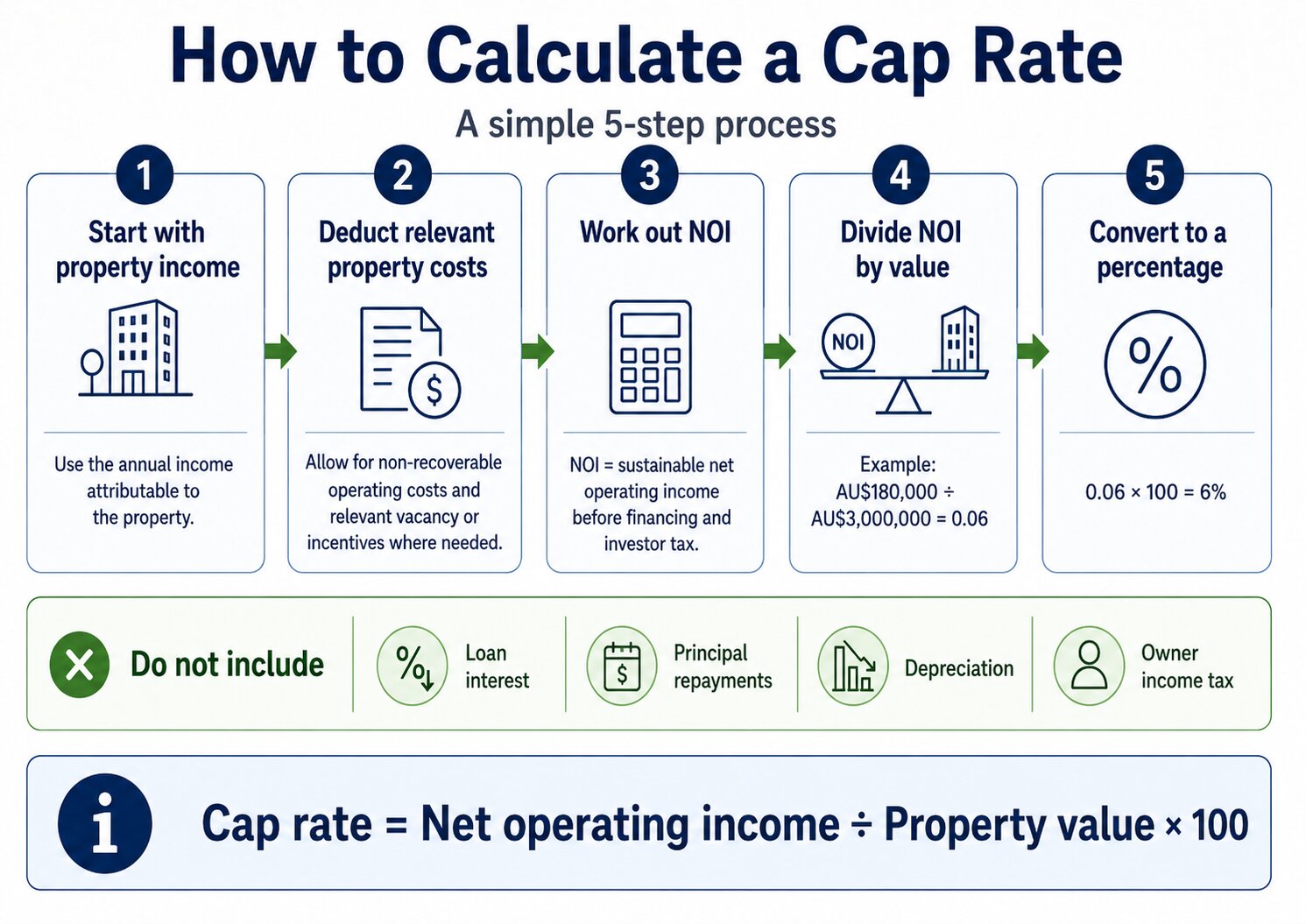
1. Start with annual property income
Use income attributable to the property, not the owner’s personal cash flow.
2. Work out net operating income
Deduct property-level operating costs that are not recovered from tenants and adjust for the income basis being used. Vacancy, incentives and management costs may also affect the relevant net figure.
Do not deduct loan interest, principal repayments, depreciation or the owner’s income tax. Those depend on the investor, not the operating performance of the property.
3. Confirm the current value or purchase price
For a completed transaction, use the purchase price on the same basis as your comparable evidence. For an existing asset, use current market value rather than a historic acquisition price.
4. Divide NOI by value
Net operating income = $180,000
Property value = $3,000,000
$180,000 ÷ $3,000,000 = 0.06
5. Convert the decimal to a percentage
0.06 × 100 = 6%
The property’s cap rate is 6%.
What counts as net operating income?
This is where apparently identical cap-rate calculations can stop being comparable.
For a simple calculation, think of NOI as sustainable property income before financing and investor-specific tax.
A practical starting structure is:
Gross property income
less vacancy and credit loss, where relevant
less non-recoverable operating expenses
equals net operating income
The exact treatment of recoverable outgoings, incentives, vacancy and unusual income should match the market evidence you are comparing against.
That matters because Australian property practice uses several yield measures based on different definitions of income. If comparable sales are analysed on one basis and the subject property on another, the maths can be correct while the comparison is wrong.
Gross rent is not NOI
Dividing headline rent by purchase price gives a gross yield, not a properly comparable net capitalisation rate.
Two properties can collect the same rent but leave very different income for the owner after vacancies, incentives, management, maintenance and unrecovered costs.
How cap rate changes property value
Cap rate and value move in opposite directions when income is held constant.
Lower cap rate = higher value
Higher cap rate = lower value
Using the same $180,000 annual NOI:
At 5.5%: $180,000 ÷ 0.055 = about $3.27 million
At 6.0%: $180,000 ÷ 0.06 = $3.00 million
At 6.5%: $180,000 ÷ 0.065 = about $2.77 million
A move from 5.5% to 6.5% changes the indicated value by roughly $503,000 even though the NOI is identical.
That sensitivity is why commercial property market reports pay so much attention to cap-rate movements.
5.5% → $3.27m
6.0% → $3.00m
6.5% → $2.77m
Assumption: constant NOI of $180,000 a year.
What is a good cap rate?
There is no universal good cap rate.
A higher cap rate gives more current income for each dollar of value, but the market may be offering that extra income because it sees more risk.
A lower cap rate means buyers are willing to pay more for the same income. That can reflect a stronger tenant, longer lease certainty, a better location, higher-quality building, stronger growth expectations or simply deeper buyer demand.
So a 7% cap rate is not automatically better than 5%.
The useful question is:
Is this cap rate enough return for the income risk, lease profile, asset quality and market I am buying?
What makes cap rates move?
Cap rates move when investors change what they are willing to pay for a given income stream.
The main drivers are:
Interest rates and bond yields. Property competes with other investments for capital. KPMG describes cap rates conceptually as a risk-free rate plus a property risk premium, while noting that the relationship is not mechanical from quarter to quarter.
Tenant covenant and lease security. Stronger tenants and longer secure income can support tighter pricing.
Passing rent versus market rent. Under-rented assets may carry reversionary upside. Above-market leases can carry downside at expiry.
Location, asset quality and liquidity. Prime assets in deep markets generally attract more buyers and lower required returns.
Vacancy and leasing risk. Near-term expiry, large vacancies or difficult-to-lease space can push required returns higher.
Capital expenditure. Major upgrades or obsolescence can increase the return investors require.
Growth expectations. Strong expected rental growth can support a lower cap rate because buyers are paying for future income as well as today’s rent.
There is no fixed rule that a one percentage point change in interest rates causes the same change in property cap rates.
Recent Australian evidence shows why. CBRE reported that prime Australian CBD office yields were mostly stable in Q2 2026 despite higher debt costs, with stronger rental growth supporting pricing. In industrial markets, national super-prime midpoint yields were also broadly stable, with only marginal outward movement in selected markets as elevated bond yields influenced expectations.
Cap rate compression vs cap rate expansion
Cap rate compression means cap rates fall. If income stays constant, the indicated value rises.
Cap rate expansion means cap rates rise. If income stays constant, the indicated value falls.
For example, take a property with $500,000 of NOI.
At 6.5%, indicated value = about $7.69 million.
At 6.0%, indicated value = about $8.33 million.
A 50-basis-point compression creates roughly $641,000 of value movement in this simplified example without changing the NOI.
Real assets rarely hold everything else constant, but the example isolates the pricing effect.
Cap rate vs yield: are they the same thing?
The terms are often used loosely, but they are not always the same measure.
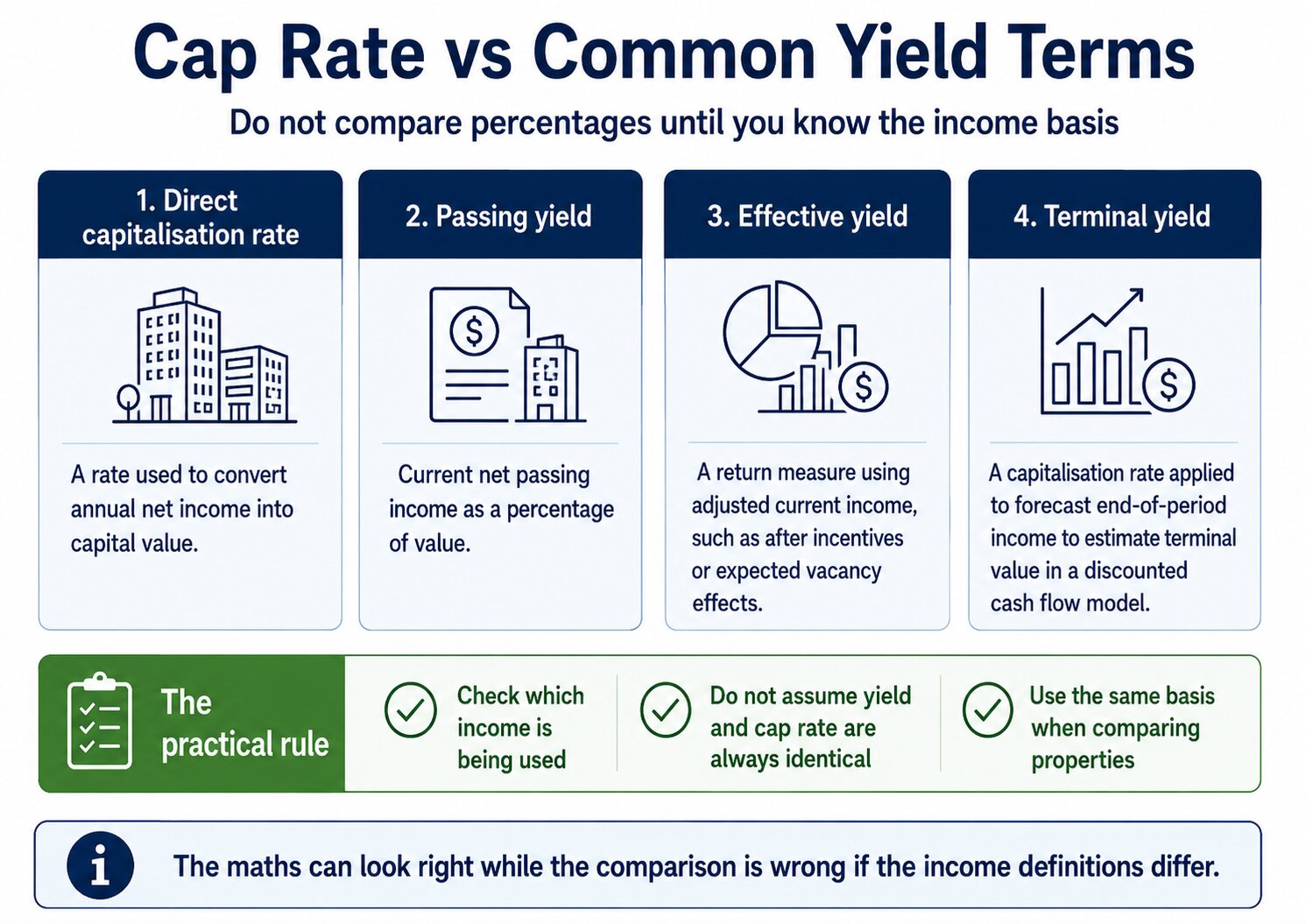
The Property Council of Australia distinguishes several terms used in Australian property:
Direct capitalisation rate
A rate used to convert annual net income into capital value.
Initial or passing yield
Current net passing income as a percentage of value, without assuming future rental growth.
Effective yield
A return based on current net income after adjustments such as incentives or impending vacancy.
Terminal or exit yield
A capitalisation rate applied to expected income at the end of a forecast period to estimate terminal value in a discounted cash flow model.
The practical rule is simple: do not compare two percentages until you know which income each one uses.
If an investment memorandum says “yield 5.8%”, ask what type of yield it is and how it was calculated.
When cap rate works well, and when it does not
Direct capitalisation works best when the property has a reasonably stabilised income stream and there is good comparable sales evidence.
It becomes less reliable when one year of income does not represent the economics of the asset, such as a property with a major vacancy, an approaching tenant expiry, passing rent far above or below market, major capital expenditure or a development/repositioning programme.
In those situations, a discounted cash flow can be more useful because it models changing rent, vacancy, incentives, expenditure and resale over multiple years.
Professional valuers often use more than one method and reconcile the results.
How cap rate fits into commercial property valuation
Cap rate is one part of the valuation story.
Our commercial property valuation guide covers the broader methods used to assess commercial assets, including income capitalisation, direct comparison and discounted cash flow.
The cap-rate method forces two questions into the open:
What is the sustainable net income?
What rate is the market applying to income with this risk profile?
If either answer is weak, the valuation is weak.
This is why the “right” cap rate does not come from a generic internet table. It is inferred from comparable transactions and adjusted for differences in location, tenancy, lease expiry, asset quality, growth prospects and other risks.
For an acquisition, disposal, financial report or lending decision, use a qualified valuer and current market evidence.
How Inspace fits into investor relations and asset sales
A cap rate compresses an investment story into one number. Buyers still need to understand what sits behind that number.
Tenant quality, lease profile, asset condition, location, vacancy, floorplates, capital works and supporting documents all influence how investors judge the risk of the income stream.
Inspace for Investor Relations brings asset data, reports, media, maps, 3D models and virtual tours into one interactive investor experience. Inspace for Asset Sales lets sales teams present the same context to buyers, personalise the experience and track engagement.
That does not replace valuation analysis. It makes the evidence behind the investment case easier to inspect.
A spreadsheet can show the cap rate. An interactive asset presentation can show investors the property and supporting context that explain why the market should price the income at that rate.
Request a demo to see how Inspace can present an investment opportunity or asset sale in one trackable digital experience.
Frequently asked questions
What does a 6% cap rate mean?
A 6% cap rate means the property’s annual net income is equal to 6% of its value. For example, $180,000 of NOI on a $3 million property equals a 6% cap rate.
Is a higher cap rate better?
Not automatically. A higher cap rate means more current income per dollar of value, but it can also indicate higher perceived risk. Compare the tenant, lease term, vacancy, location, asset quality, capital expenditure and growth prospects.
How do you calculate capitalisation rate?
Divide annual net operating income by the property’s value or purchase price, then multiply by 100. A property with $300,000 of NOI and a $5 million value has a 6% cap rate.
Does cap rate include mortgage payments?
No. Debt service is excluded because cap rate measures the property independently of an investor’s financing structure.
What is cap rate compression?
Cap rate compression means the market cap rate falls. If NOI stays constant, the indicated value rises.
What is cap rate expansion?
Cap rate expansion means the market cap rate rises. If NOI stays constant, the indicated value falls.

%201.svg)