

What Is an Information Memorandum (IM)? Structure, Template & Best Practice
September 1, 2026
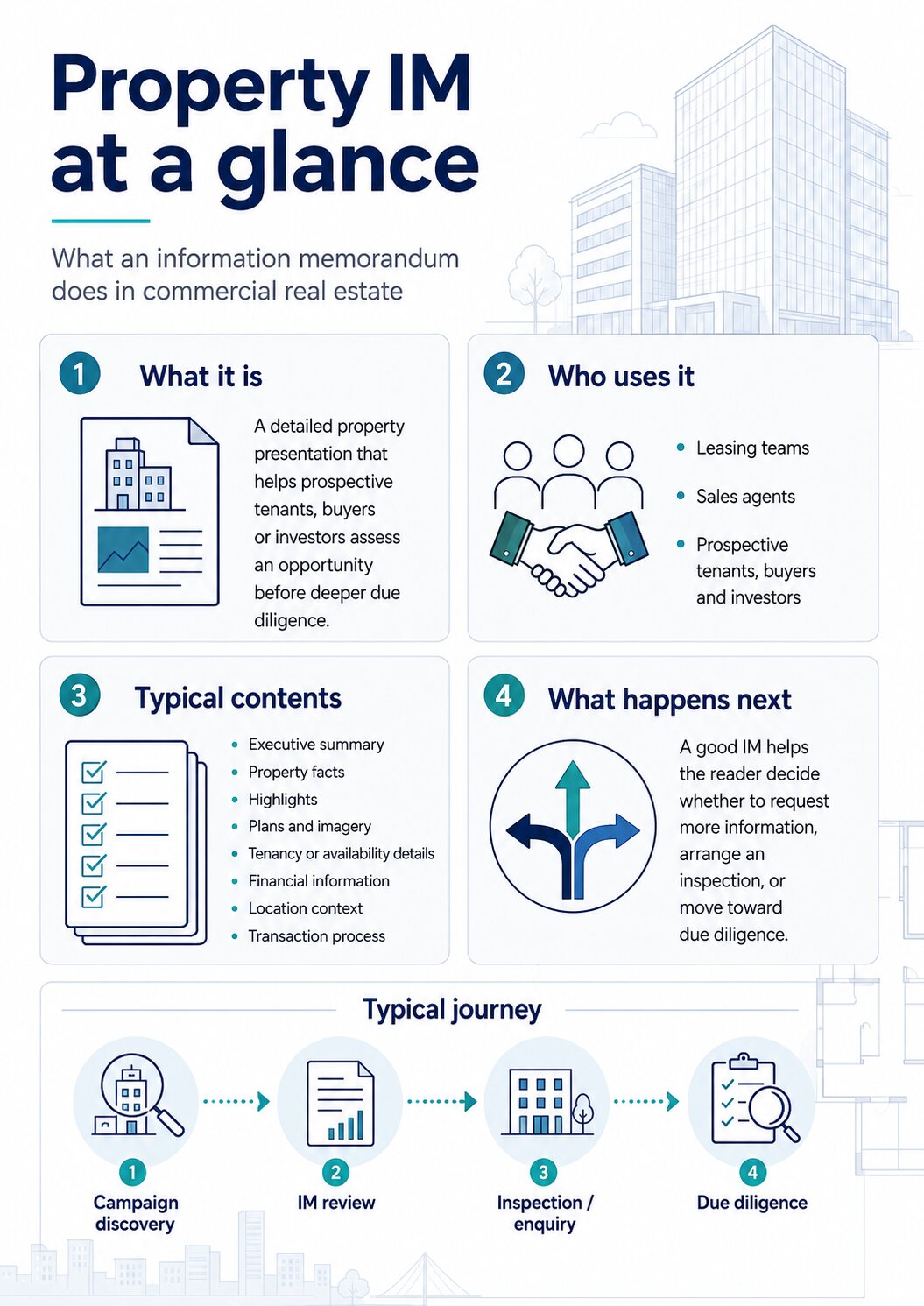
In commercial real estate, an information memorandum (IM) is a detailed property presentation used to help prospective tenants, buyers or investors assess an opportunity before deeper due diligence. It brings the key facts, leasing or financial information, plans, images, location context and transaction details into one place.
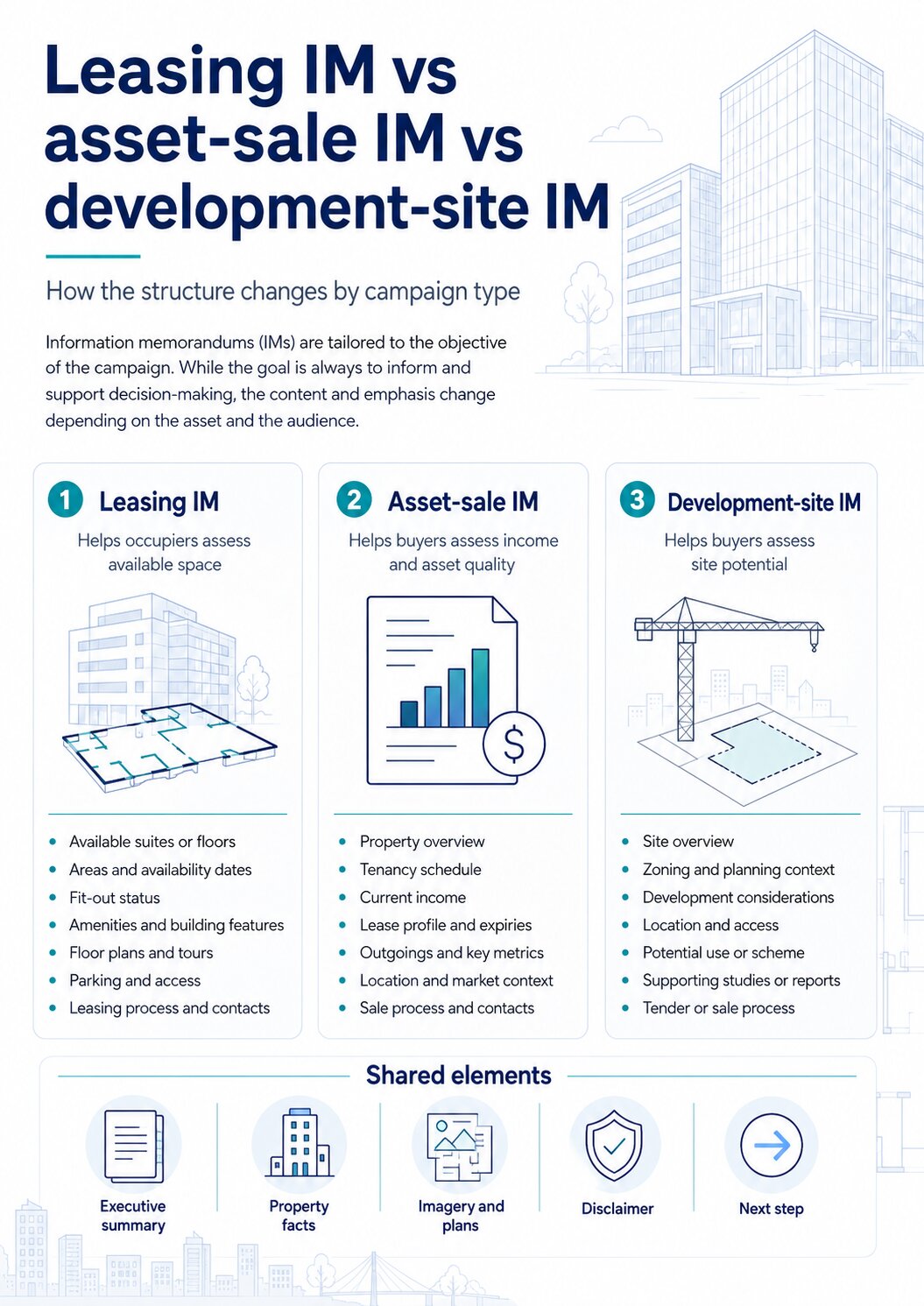
The contents change with the campaign. A leasing IM focuses on available space, fit-out and amenities. An investment-sale IM usually adds tenancy schedules, income and lease terms. A development-site IM puts more weight on zoning, planning and development potential.
A good property IM is not simply a glossy brochure. It should help a serious prospect decide whether to keep investigating, request more information or arrange an inspection.
What is an information memorandum in real estate?
A property information memorandum is a structured document or digital presentation that explains a commercial real estate opportunity in enough detail for a prospective tenant, buyer or investor to decide whether to investigate further.
A typical property IM may include:
- Executive summary
- Key property facts
- Investment or leasing highlights
- Property description and specifications
- Floor plans, site plans and photography
- Tenancy or availability information
- Financial information where relevant
- Location and market context
- Planning or zoning information where relevant
- Sale or leasing process
- Contacts
- Disclaimer and due diligence notes
There is no single industry-wide structure. A Knight Frank development-site IM for Airlie Beach included an executive summary, opportunity, site overview, location, development considerations, tender information and disclaimer. A 2026 DiJones commercial investment IM for Tuggerah included a property overview, location, tenancy schedule, financial summary, investment highlights, next steps and disclaimer.
The best structure follows the decision the reader needs to make.
Information memorandum vs brochure, teaser and data room
These documents often sit in the same campaign, but they do different jobs.
A teaser or listing advertisement creates initial interest.
A brochure is usually more visual and marketing-led.
An information memorandum sits in the middle. It tells the property story while giving the reader enough factual depth to assess the opportunity seriously.
A due diligence data room goes deeper again, with leases, title documents, surveys, reports, planning material and other underlying evidence.
A useful sequence is:
Listing or teaser → Information Memorandum → Inspection/enquiry → Data room → Due diligence → Transaction
An IM should make the next step easier. It should not try to replace every document that comes after it.
What should an information memorandum include?
The following structure is a practical starting point for a commercial property IM.
1. Cover and document status
Identify the property, transaction type and agency or owner presenting it. For sale campaigns, include the method of sale where appropriate. If the document is confidential, draft or intended for selected recipients, make that clear.
2. Disclaimer and important notice
Property IMs commonly explain that the document is a general guide and that prospective purchasers or tenants should verify the information independently.
Use wording prepared for the actual campaign. Do not copy a disclaimer from an unrelated IM. The parties, information sources, jurisdiction and transaction can all differ.
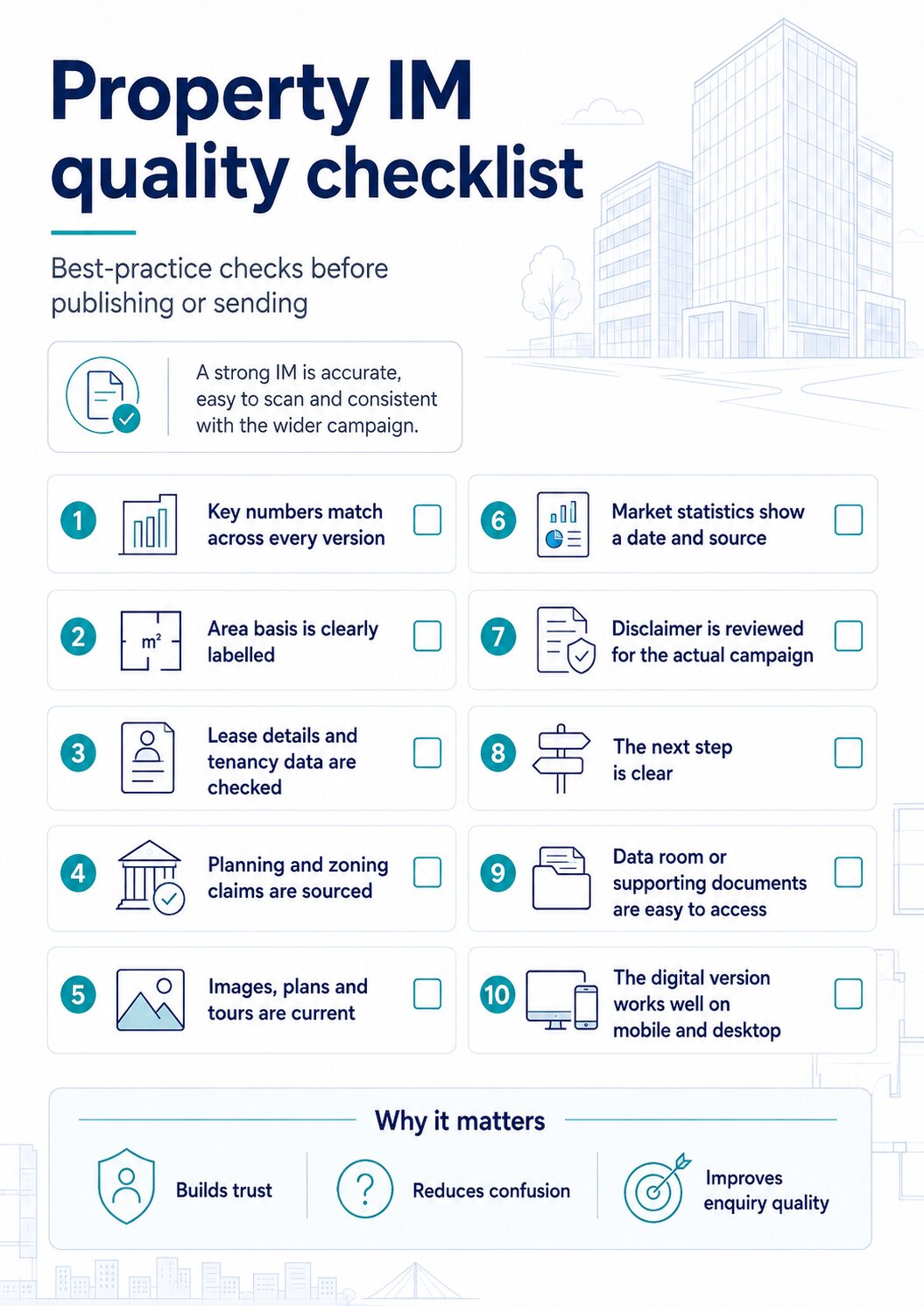
A disclaimer also does not make inaccurate content acceptable. Areas, rents, dates, lease terms and planning claims still need checking before publication.
3. Executive summary
The executive summary should let a reader understand the opportunity in under a minute.
For an investment sale, it may show the address, asset type, land and building area, occupancy, income, key lease metrics and sale method.
For leasing, it may show the available areas, fit-out status, building grade, amenities, parking and availability date.
Put the most decision-relevant facts here, then support them later.
4. Investment or leasing highlights
Avoid vague claims such as “rare opportunity” unless the next line proves why.
Specific highlights are stronger:
- “Three fully leased office suites with staggered expiries.”
- “1,250 sqm contiguous floor with existing high-quality fit-out.”
- “Development site within 600 metres of a major rail station.”
Good highlights connect a property feature to a reason it matters.
5. Property overview
Explain what the asset actually is.
Depending on the property, include site area, building area, net lettable area, construction, services, parking, loading, ceiling heights, amenities, sustainability ratings, title and zoning.
Be consistent with area definitions. If one page uses NLA and another uses gross floor area, label both clearly rather than letting the reader assume they are the same.
6. Tenancy or availability schedule
This section changes substantially by campaign type.
For an investment sale, a tenancy schedule may include tenant, area, current rent, commencement, expiry, rent reviews, options and relevant outgoings information.
For leasing, the schedule may show level or suite, area available, fit-out status, availability date, parking and links to plans or tours.
The schedule should agree with the floor plans, listing and every other campaign document.
7. Financial summary
For investment sales, make the income story easy to follow.
Depending on the asset, this can include passing or net income, recoverable outgoings, vacancies, rent reviews, incentives and lease-expiry information.
The IM does not need to reproduce a full valuation. It should show the numbers a buyer needs for initial assessment and make it clear where the underlying detail can be verified.
If the campaign discusses cap rates or yield, keep the income basis consistent.
8. Location and market context
Do more than show a pin on a map.
Explain why the location matters to the target tenant or buyer: transport, workforce, customers, amenity, infrastructure, competing supply, precinct positioning and relevant development activity.
Date market statistics and identify their source. An impressive-looking chart with no period or source is difficult to trust.
9. Plans, photography and virtual inspection
Plans, photography, aerials and virtual tours help the reader understand the physical opportunity.
For leasing, this may mean showing how an available floor relates to the building and what the fit-out looks like. For an asset sale, buyers may need to understand several tenancies, common areas, access and surrounding context.
This is also where static PDFs can become cumbersome. The more media a campaign contains, the more the reader has to jump between pages and separate links.
10. Transaction process and next steps
Do not make an interested reader search for what happens next.
State the method of sale or lease, key dates, inspection arrangements, how to request due diligence material and who to contact.
Information memorandum template for commercial property
A practical template is:
1. Cover
2. Important notice / disclaimer
3. Executive summary
4. Key investment or leasing highlights
5. Property overview
6. Tenancy or availability schedule
7. Financial summary, if relevant
8. Location and market context
9. Plans, imagery and virtual tours
10. Planning or development information, if relevant
11. Transaction process
12. Data room or supporting documents
13. Contacts
14. Final disclaimer
Not every IM needs every section. A short leasing IM and a detailed investment-sale IM can both be right if each gives the reader what they need.
What makes a good property IM?
Lead with facts, not adjectives
“Prime”, “iconic” and “rare” mean little on their own. Lead with the fact that proves the point.
Make key numbers easy to find
Do not bury the site area, income or lease-expiry profile deep in the document. Put core facts in the executive summary and support them later.
Separate fact from forecast
A current lease expiry is a fact. A projected rental uplift is an assumption. Current zoning is a fact. A future development outcome may depend on approvals. Make the difference obvious.
Keep one source of truth
Check that areas, rents, dates, tenant names, availability, floor labels and contacts match across the IM, website, listing, data room and internal material.
Write for scanning
Use short sections, descriptive headings, summary tables, bullet points, captions and consistent terminology. Readers rarely consume an IM from page one to the end on the first pass.
Make verification easy
If a figure matters, show where the reader can verify it, whether that is a lease schedule, planning report, data room, floor plan or source note.
From static PDF to interactive information memorandum
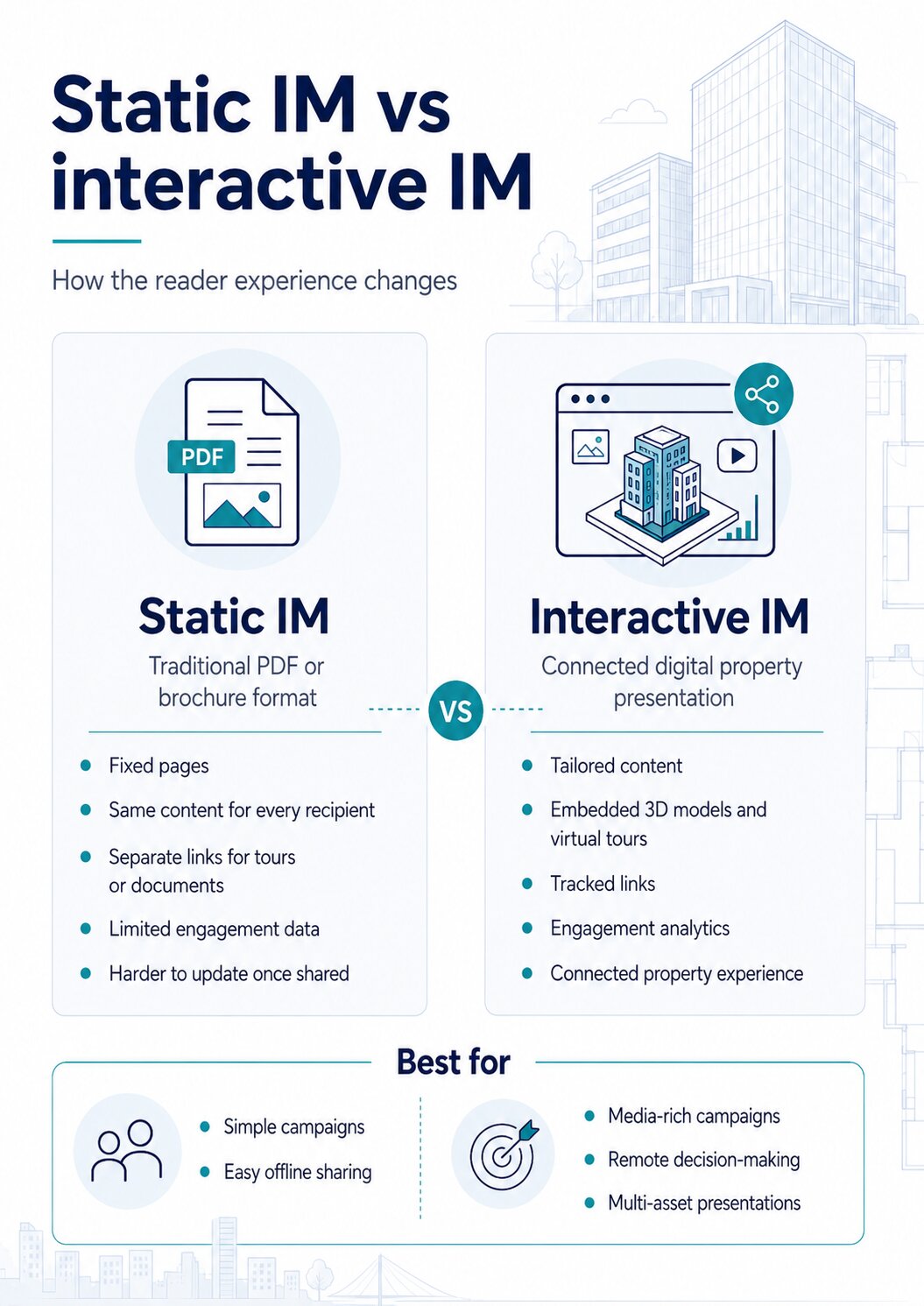
A PDF IM is portable and familiar, but commercial property campaigns increasingly contain more than fixed pages handle well.
A leasing team may need to present several availabilities, 3D building context, existing or unbuilt virtual tours, plans, fit-out options, amenities, video and property data. An asset-sale campaign may add tenancy information, financial data, buyer documents and location context.
Inspace for Leasing is designed to turn information that would normally sit in an IM into a trackable interactive presentation. A prospect can receive a unique link, see content relevant to them and move between property data, media, virtual tours and an interactive 3D asset model in one experience.
This also makes the presentation measurable. Teams can track where traffic is coming from and which assets, spaces and virtual tours receive attention.
Inspace for Asset Sales can combine virtual inspection with financial or tenancy information, media, maps and supporting collateral. Buyers can understand the asset remotely before deciding whether to travel or progress to formal due diligence.
The distinction is important: an interactive IM does not replace legal or due diligence material. It improves the presentation and early evaluation stage.
For a single asset, the experience can sit inside an Inspace 3D Stack. For a multi-asset campaign, Inspace Digital Portfolio can bring several 3D Stacks together into one portfolio-level presentation.
When should you use a property information memorandum?
Use an IM when the opportunity is too complex for a listing page or brochure, but the prospect is not yet at full due diligence.
Common uses include office, retail and industrial leasing, commercial investment sales, portfolio sales, development sites, sale-and-leaseback campaigns and pre-leasing.
A simple rule: if the prospect needs several facts, plans, financial inputs or pieces of media to decide whether to proceed, an IM is usually the right layer of information.
Frequently asked questions
What does IM mean in real estate?
IM stands for information memorandum. In commercial real estate, it is a detailed presentation used to help prospective tenants, buyers or investors assess a property before deeper due diligence.
What is included in a property information memorandum?
A property IM commonly includes an executive summary, property facts, investment or leasing highlights, property details, tenancy or availability information, financial information where relevant, location context, plans, imagery, transaction process, contacts and a disclaimer.
Is an information memorandum the same as a prospectus?
No. A property IM is generally a commercial presentation used in a leasing or sale process. A prospectus is a regulated disclosure document used for certain securities offers. The terms should not be treated as interchangeable.
Is an information memorandum legally binding?
A property IM is commonly presented as a guide rather than the transaction contract itself, and recipients are usually told to verify information independently. The legal effect depends on the document and transaction, so campaign wording should be reviewed by appropriate advisers.
How long should an information memorandum be?
There is no ideal page count. A straightforward leasing IM may be short, while an investment-sale or development-site IM may run to dozens of pages. The right length is the shortest version that lets a serious reader assess the opportunity properly.
What is an interactive information memorandum?
An interactive IM presents property information digitally rather than only as fixed PDF pages. It can combine data, imagery, 3D models, virtual tours, plans and documents, while allowing teams to tailor and track prospect links.

%201.svg)