

How to Sell Commercial Property in Australia: The Process, and the Tax That Decides What You Keep
September 2, 2026
Selling a commercial property runs through five stages: work out what it is worth and on what basis, choose a method of sale, prepare the disclosure your state requires, market it to buyers who can actually settle, then negotiate and complete.
That is the process. It is not the hard part.
The hard part is that two tax questions, both settled long before the property is advertised, routinely move more money than the entire marketing campaign. One decides whether 10% of the sale price goes to the Australian Taxation Office or stays in the deal. The other decides whether the gain is taxed in full or reduced to nothing. Get either wrong and no amount of good photography recovers it.
This guide covers both, along with the process, the disclosure rules that changed recently in two states, and what selling commercial property actually costs.
This is general information about commercial practice, not tax or legal advice. Your position depends on your structure, your history with the asset and your state. Talk to an accountant and a property lawyer before you sign anything or exchange contracts.
First, what your property is worth, and on what basis
Commercial property is priced on income. A buyer takes the net income the property produces and divides it by the yield they require, and that gives them a value. The lease you have in place is not a detail of the sale, it is most of the product.
That means three things decide your price before a photograph is taken: the income, the quality and length of the covenant producing it, and the yield the market applies to that combination. Our guide to valuing commercial property covers the methods in full, and the cap rate explainer covers the yield side.
What matters for a sale is narrower. Before you go to market, know which of those three you can still influence. A lease with two years left prices very differently from the same lease re-signed for five, and re-signing it is often the highest-return work available to a vendor. Rent that is under market can sometimes be reviewed before sale. Vacancy can sometimes be filled. None of that is possible once the property is listed and buyers are running their own numbers.
The two tax questions worth more than your marketing campaign

Both questions turn on the same fact: is there a tenant in the property, and who is it?
That single fact pushes the two big tax reliefs in opposite directions. A lease to an unrelated tenant makes the GST exemption available and blocks the capital gains tax concessions. Occupying the property yourself does the reverse. Very few vendors realise these two work against each other, and the ranking guides on this topic treat them as separate topics on separate pages.
Question one: will the sale carry GST?
The default is that it will. The ATO states that when you sell commercial premises “you’re generally liable for GST on the sale price”. On a $3 million property that is $300,000, and whether the buyer can claim it back does not make it free, because it still has to be funded at settlement.
There are two ways it can be less.
The going concern exemption makes the sale GST-free. The ATO sets out the conditions, and all of them must be met.
The condition that catches people is the fourth, and the ATO says the quiet part out loud: ”The sale of a property by itself isn’t regarded as a going concern.” An empty building sold with nothing else attached does not qualify. What makes a commercial property a going concern is usually the leasing enterprise, meaning the property sold with its lease in place and the tenancy running through to settlement. Sell the same building with vacant possession and the exemption goes with the tenant.
The written agreement in condition three is not a formality either. It has to be in the contract, agreed by both parties, and it has to be there before the sale, not reconstructed afterwards.
The margin scheme is the other route, and it is a reduction rather than an exemption. Under it, the ATO explains, “your GST liability is one-eleventh of the margin on the sale of the property, rather than one-eleventh of the total selling price”. It is only available if the sale is taxable in the first place, and eligibility depends on how you acquired the property.
One thing vendors miss in the other direction: you can claim GST credits on the costs of selling. The ATO confirms sellers “can claim GST credits on your purchases that relate to selling the property”, which covers agent fees and the rest of the sale costs, subject to the normal rules.
Question two: how much of the gain do you keep?
Capital gains tax applies to the difference between your cost base and what you receive. Two reliefs can reduce it, and they are not the same relief.
The CGT discount is the general one. Hold the asset at least 12 months and, per the ATO, individuals and Australian trusts “reduce your capital gain by 50%”, complying super funds by 33.33%. Companies cannot use it at all. If the property sits in a company, that is a structural fact worth knowing years before you sell, because it cannot be fixed at the point of sale.
The small business CGT concessions are the powerful ones, and there are four: the 15-year exemption, the 50% active asset reduction, the retirement exemption and the roll-over. Applied well they can reduce a gain to nothing. To reach them you need aggregated turnover under $2 million or a maximum net asset value where the total net value of your CGT assets, plus connected entities and affiliates, “must not exceed $6 million”.
And the asset has to pass the active asset test. This is where commercial property gets interesting.
An active asset is one you use, or hold ready for use, in running a business. But the ATO excludes assets whose “main use is to derive rent”. A commercial property leased to an unrelated tenant is, by definition, mainly used to derive rent. So the lease that qualified you for the going concern exemption is the same lease that disqualifies you from the small business CGT concessions.
There is an important exception. An asset leased to a connected entity or affiliate can still be active, judged on how that entity uses it. The common Australian structure, where the premises sit in a trust or self managed super fund and are leased to the owner’s own operating company, is built on exactly this point. The exclusion is aimed at passive landlords, not at business owners who happen to hold their premises in a separate entity.
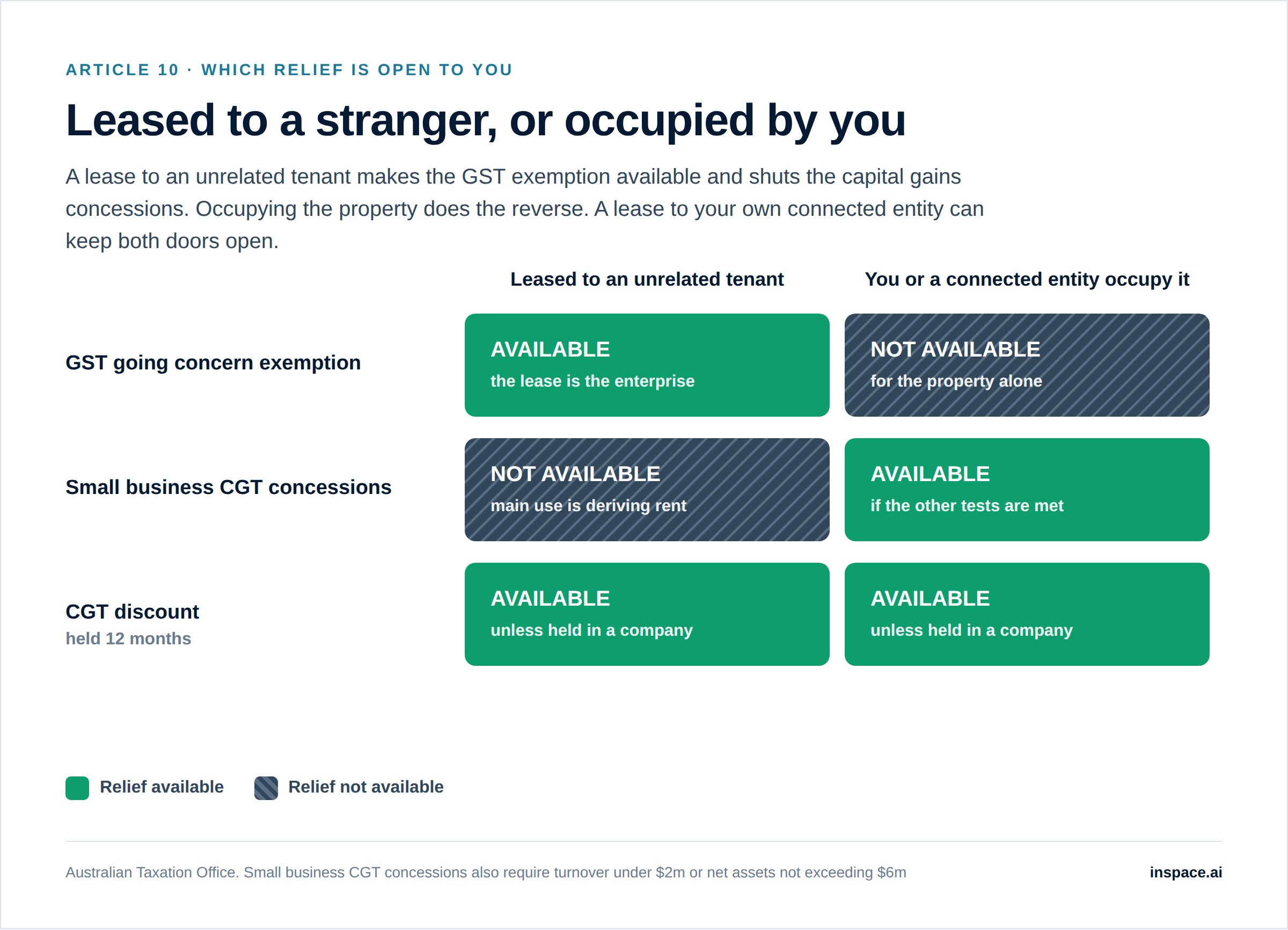
Read across those rows and the planning problem is obvious. The two reliefs rarely both apply, so the question is which one is worth more in your circumstances, and that is an arithmetic question your accountant should answer before the property is listed rather than after a contract is signed.
Choosing how to sell it
Australian commercial property is sold four ways. The choice is not about tradition, it is about how many credible buyers exist for this specific asset and how much price discovery you need.
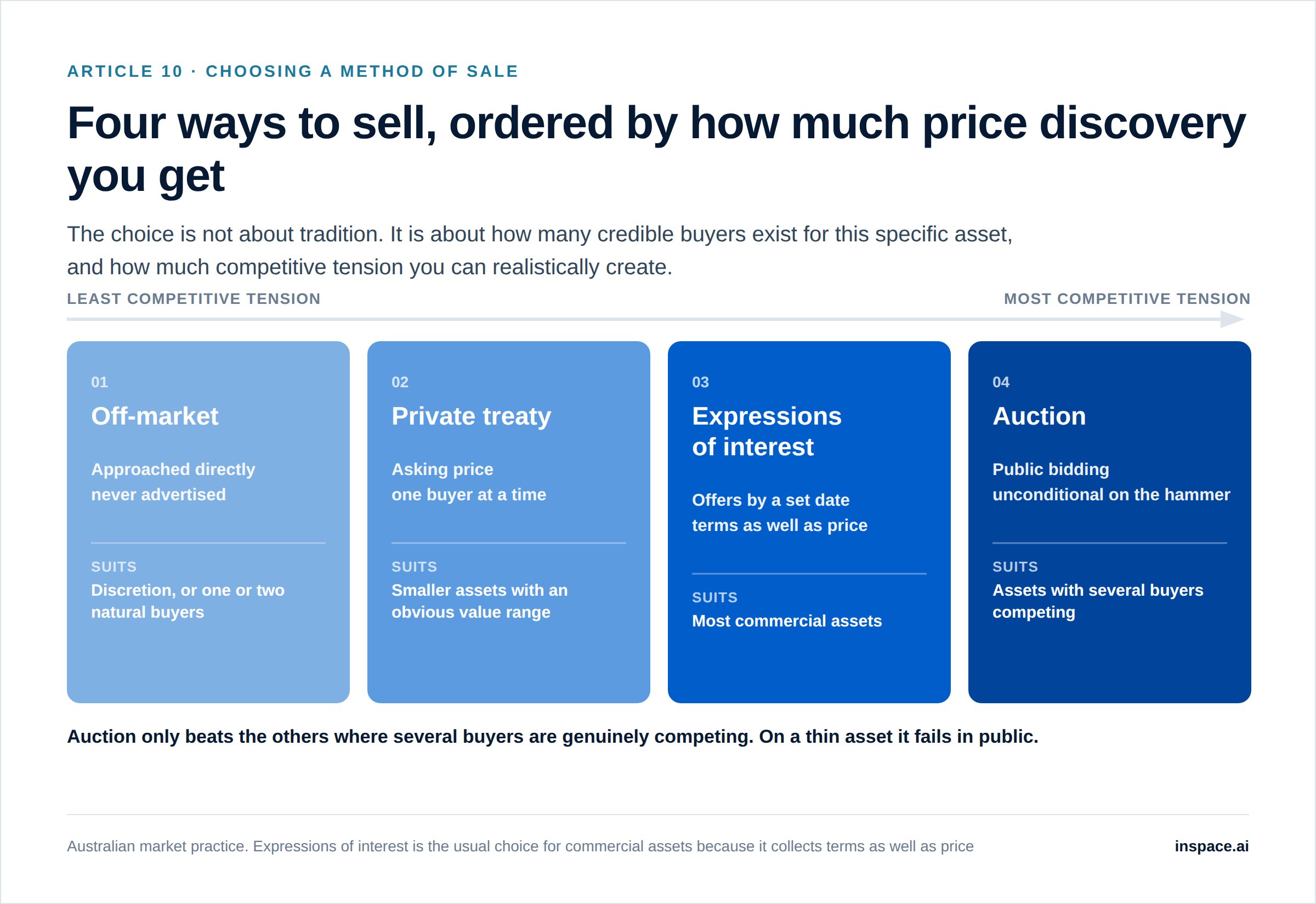
Auction deserves a warning. Because bidding is unconditional, every serious bidder has to finish their due diligence and arrange finance before auction day, at their own expense, knowing they may not win. That filters the pool hard. On an asset with three hungry buyers it produces the best result available. On an asset with one, it produces a public failure that follows the property around.
Expressions of interest is the workhorse for commercial assets because it collects terms as well as price. The highest number is not always the best offer once you weigh a shorter due diligence period, a bigger deposit, or a buyer who does not need finance.
What you have to disclose, and it now depends on your state
This has changed recently and the ranking guides have not caught up.
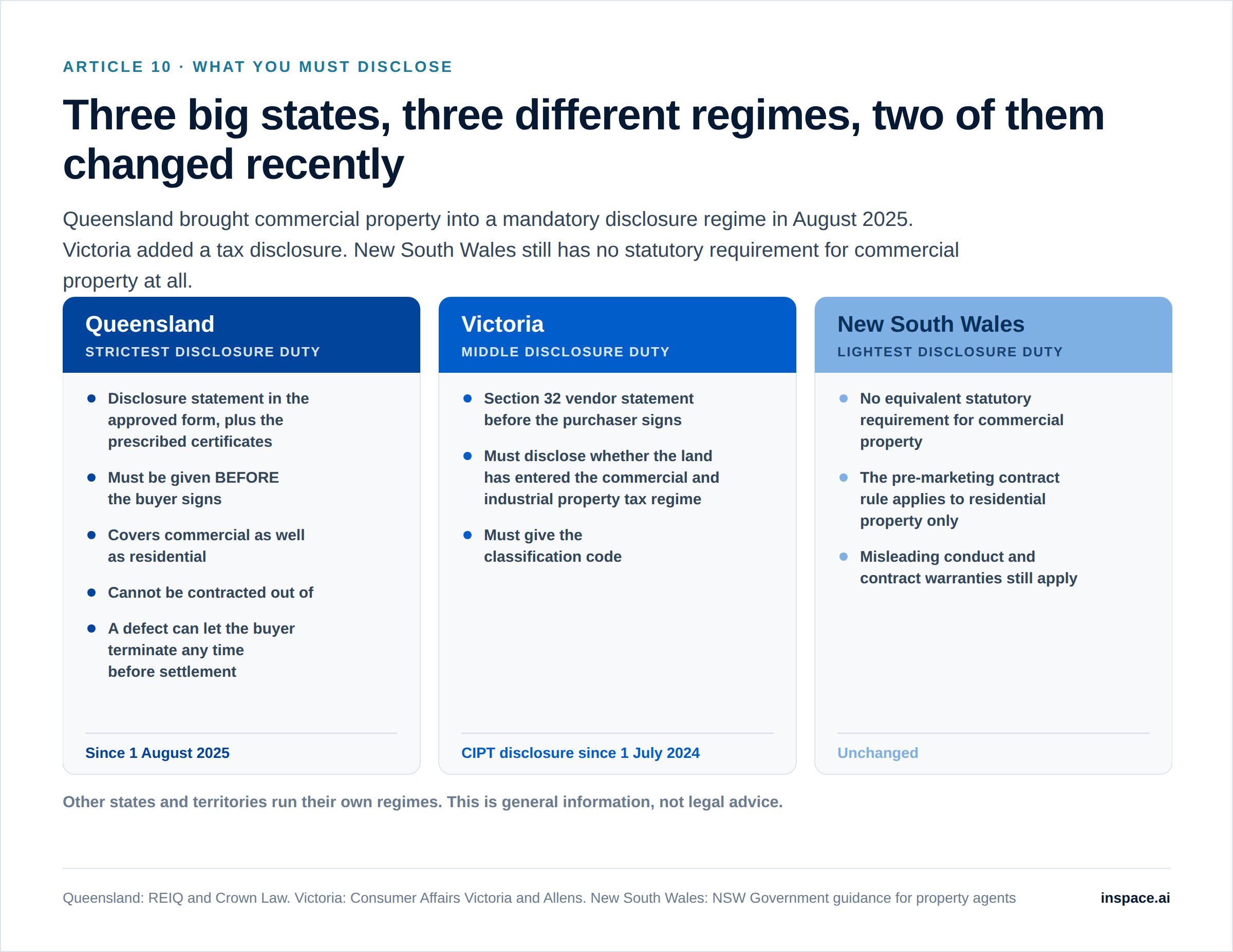
The Queensland change has teeth. Get the disclosure wrong and, per the REIQ, “the buyer may be entitled to terminate a contract of sale any time before settlement if the disclosure documents are not provided correctly, or there is a mistake or omission that relates to a material matter”. That is a termination right hanging over the deal right up to the day money changes hands.
The New South Wales position surprises people, including some vendors who assume the residential rule applies to them. It does not. That is not permission to disclose nothing, because misleading conduct and contractual warranties still apply, but there is no statutory pre-marketing document.
If the property is in Victoria, your buyer’s maths changed
Anyone selling commercial or industrial property in Victoria needs to understand what the buyer is now calculating, because it is not what it was before 1 July 2024.
Under the commercial and industrial property tax reform, a Victorian commercial or industrial property is subject to stamp duty one final time when it is next sold or transacted on or after 1 July 2024, and that transaction brings the land into the new scheme. A ten year transition period then runs from that entry date. After it, an annual tax applies at 1% of the land’s site value, its unimproved value, with no tax-free threshold. Build to rent land is charged at 0.5%.
To soften the entry cost, buyers can pay the duty upfront or, if eligible, take a government transition loan administered by the Treasury Corporation of Victoria and repay it in equal annual instalments over ten years, where the purchase price does not exceed $30 million.
Three consequences for a vendor:
If your property has already had its entry transaction, that is a selling point. The next buyer inherits a property already in the scheme and does not pay duty again on purchase. Say so, and prove it.
If it has not, your buyer is pricing in a final stamp duty bill plus a future annual tax. That lands in their offer whether or not anyone discusses it.
You have to disclose the position in the vendor statement, including the classification code. Victoria also restricts what can be adjusted between vendor and purchaser at settlement, so treat the tax position as something to price in rather than something to fix with a special condition.
What it costs to sell
Four cost groups, and the first is the one people underestimate least accurately.
Agent commission is negotiated, not fixed, and the rates for selling commercial property vary far more than residential ones because the assets and the work vary more. Rates depend on the value, the asset type, the method of sale and whether marketing is charged separately. Anyone quoting you a single standard commercial percentage without asking about the asset is guessing. Get two or three proposals in writing and compare the total cost including marketing, not just the headline rate.
Marketing is usually charged to the vendor on top of commission, either as a fixed campaign budget or at cost.
Legal and conveyancing covers the contract, the disclosure documents, and the negotiation of special conditions. In Queensland and Victoria the disclosure obligations make this more substantial than it used to be.
Tax, which is the largest number on the list for most vendors and the one that is most within your control if you plan early. Remember the GST credits available on the selling costs themselves.
The information a buyer actually needs
Commercial buyers do a different job from residential ones. They are underwriting an income stream, so they need the lease, the rent roll, the outgoings history, the area schedule, the capital expenditure record, and enough about the building to know what they are inheriting. Most of that lives in an information memorandum, and our guide to information memorandums covers what belongs in one.
The practical failure is rarely that this information does not exist. It is that it arrives in eleven attachments across four emails, in different formats, with an area figure in the brochure that does not match the area figure in the lease. Every inconsistency a buyer finds is a reason to re-check everything else, and re-checking costs them time and you momentum.
Areas deserve particular care, because rent is a rate multiplied by an area and an inconsistent area quietly changes the income the buyer is underwriting. Our guide to net lettable area explains what should and should not be inside that number.
Presenting an asset to buyers who have never stood in it
Most serious buyers for a commercial asset are not local. They are assessing your property against others they will also never visit, from an office in another city, using whatever you sent them.
Inspace puts the whole asset into one interactive model: floor plates, tenancy areas, availability and asset data in one place, with virtual tours of the real space, so a buyer can understand the building without flying to it and everyone is working from the same numbers. It has been used across more than $190 billion of real estate and identifies anonymous viewers with 90% accuracy, which tells you who is actually engaged rather than who replied to the email.
Request a Demo to see how your asset would present.
Frequently asked questions
What is the best way to sell a commercial property?
It depends on how many credible buyers exist for that specific asset. Expressions of interest suits most commercial property because it collects terms as well as price and creates a deadline without forcing buyers to go unconditional. Auction produces the best result where several buyers are genuinely competing, but it exposes a weak outcome publicly and requires bidders to complete due diligence at their own cost beforehand. Private treaty suits smaller assets with an obvious value range. Off-market suits vendors who need discretion and accept they will not discover the market price.
Do I have to pay GST when I sell a commercial property?
Generally yes. The ATO states that when you sell commercial premises you are generally liable for GST on the sale price. Two things can change that. The going concern exemption can make the sale GST-free where all the conditions are met, which in practice usually means selling a tenanted property with the lease in place. The margin scheme can reduce the liability to one-eleventh of the margin rather than one-eleventh of the price, where the sale is taxable and you are eligible.
What is a going concern, and does my property qualify?
A going concern sale is GST-free where the sale is for payment, the purchaser is registered or required to be registered for GST, both parties agree in writing that it is a going concern, the seller supplies everything necessary for the continued operation of the business, and the seller carries the business on until the day of sale. The critical point is the ATO’s own statement that the sale of a property by itself is not regarded as a going concern. A tenanted property sold with its leasing enterprise intact can qualify. An empty building sold on its own does not.
Who pays the GST on the sale of a commercial property?
The seller is liable to remit it, and it is normally added to the price so the buyer funds it at settlement. A buyer registered for GST can usually claim it back as a credit, but that happens after settlement, so the money still has to be found on the day. This is why the going concern treatment matters commercially as well as fiscally: it removes a large amount of cash from the settlement.
How is capital gains tax calculated on a commercial property?
The gain is the difference between the cost base, being what it cost you to acquire and improve the property, and what you receive on sale. If the asset was held for at least 12 months, individuals and Australian trusts can discount the gain by 50% and complying super funds by 33.33%. Companies cannot use the CGT discount. Small business CGT concessions may then reduce the remaining gain further if you qualify.
How can I legally reduce capital gains tax on a commercial property?
The main levers are the 12-month CGT discount and the four small business CGT concessions: the 15-year exemption, the 50% active asset reduction, the retirement exemption and the roll-over. The small business concessions require aggregated turnover under $2 million or net assets not exceeding $6 million, and the property must pass the active asset test. A property whose main use is deriving rent from an unrelated tenant fails that test, though a property leased to a connected entity or affiliate can still qualify. Timing of the sale, the ownership structure and which entity holds the asset all matter, which is why this is a conversation to have well before listing.
Can I get both the GST going concern exemption and the small business CGT concessions?
Rarely, because they pull in opposite directions. The going concern exemption generally needs a lease in place, and a property whose main use is deriving rent is excluded from being an active asset for the small business CGT concessions. The exception is a property leased to a connected entity or affiliate, which can remain an active asset. Work out which relief is worth more in your circumstances before you decide whether to sell tenanted or with vacant possession.
What do I have to disclose when selling commercial property?
It depends on the state. In Queensland, since 1 August 2025, a seller must give a disclosure statement in the approved form and prescribed certificates before the buyer signs, and this applies to commercial as well as residential property. In Victoria a section 32 vendor statement is required before signing, and it must now also disclose whether the land has entered the commercial and industrial property tax regime. In New South Wales there is no equivalent statutory requirement for commercial property, because the pre-marketing contract rule applies to residential property only.
How much does it cost to sell a commercial property?
The main costs are agent commission, marketing, legal and conveyancing, and tax. Commercial commission is negotiated and varies widely with the value, asset type and method of sale, so compare written proposals on total cost including marketing rather than on the headline percentage. Tax is usually the largest figure and the most controllable, provided it is planned before the property is listed. GST credits can generally be claimed on the selling costs.
Should I sell my commercial property with a tenant in place or vacant?
Tenanted usually prices better, because commercial property is bought for its income and a lease with a solid covenant and reasonable term is most of the value. A tenancy is also what makes the GST going concern exemption available. Vacant possession suits a narrower group, mainly owner-occupiers and developers, and it is the position that keeps the small business CGT concessions open where you or a connected entity have been using the property in a business. The right answer depends on which buyer you are selling to and which tax relief is worth more to you.
How long does it take to sell a commercial property?
Plan on the preparation taking as long as the campaign. Getting the lease documentation, outgoings history, area schedules and state disclosure documents in order commonly takes several weeks, and in Queensland and Victoria the disclosure obligations have to be complete before a buyer signs. The campaign itself typically runs four to six weeks for an expressions of interest process, followed by contract negotiation and a settlement period that is negotiated rather than fixed.
Do I need an agent to sell commercial property?
No, but the buyer pool for commercial assets is far less visible than for residential, and much of it is reached through relationships rather than portals. If you sell privately you take on the marketing, the buyer qualification, the negotiation and the coordination of disclosure yourself. The question is not whether it can be done, it is whether the price difference and the risk of a failed campaign outweigh the commission.

%201.svg)